
MUSIC AND SPIRITUALITY
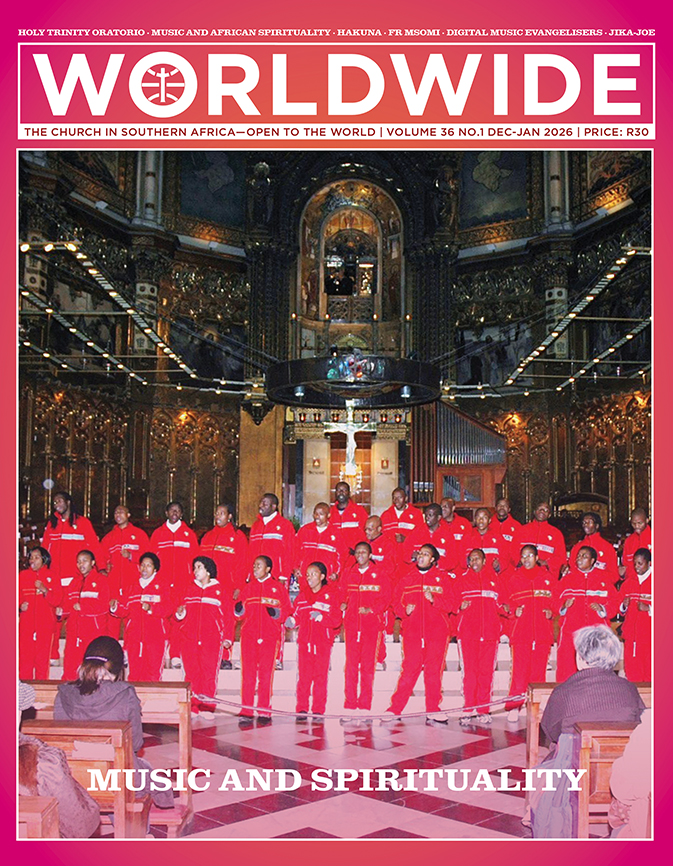
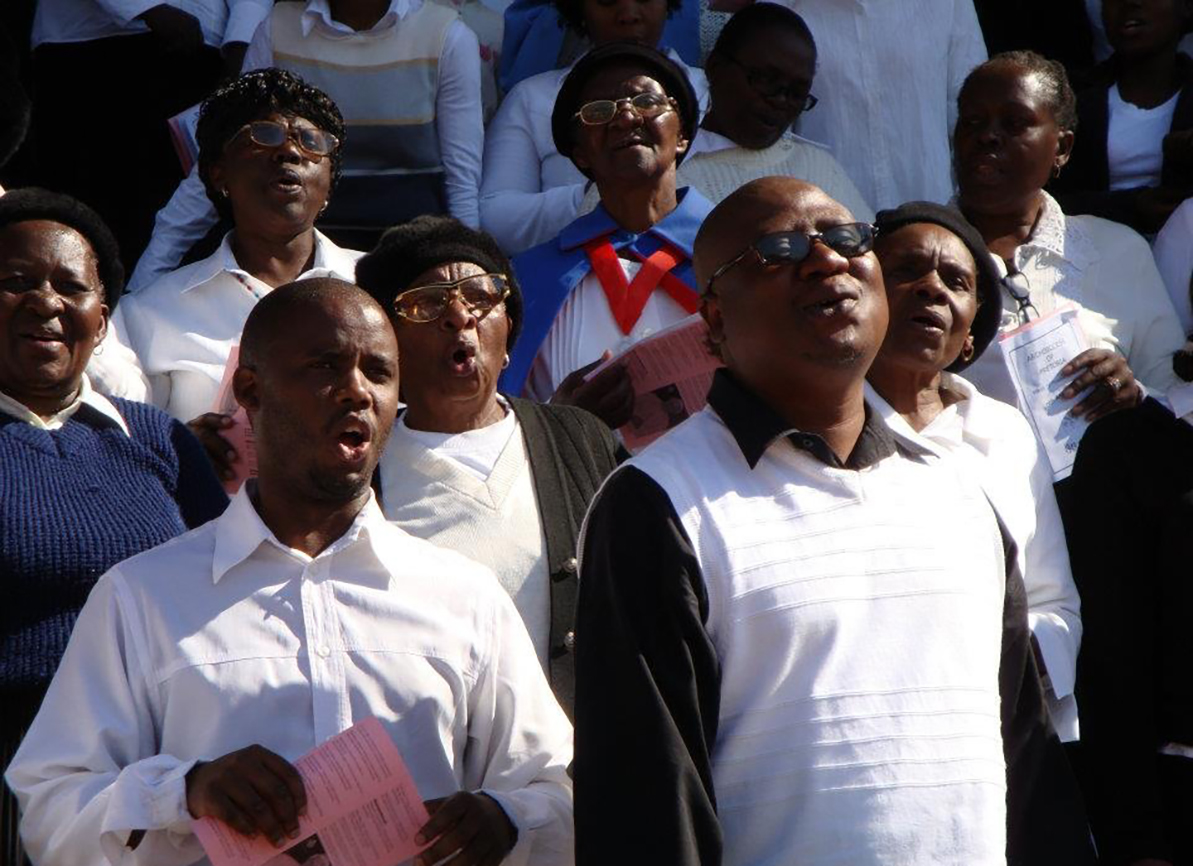
The choir Izwi le Themba (voices of hope in isiZulu) from Saint Daniel Comboni Parish at Mahube Valley, Mameldi, Pretoria, singing at Montserrat Abbey in Barcelona, during their concert tour to Spain in 2008. The group’s name conveys a deep meaning rooted in one of the reasons for singing: to bring hope to the world.
Credit: Fr James Calvera MCCJ.
Special Report • HAKUNA MUSIC GROUP
When music serves no purpose: Hakuna and evangelisation by attraction
In 2013, a Catholic movement appeared on the eve of the preparations for World Youth Day 2013 in Rio de Janeiro. It was named Hakuna. It now has a presence in more than 20 countries. Through Eucharistic adoration, retreats, training, and getaways, its members seek to live and spread God’s life in the ordinary world. The movement has a music group, Hakuna Music Group, which emerged from the songs written for moments of adoration, but eventually it took on a life of its own.
BY Marcos Benítez Cruz | Argentinian philosopher, Madrid, Spain
WE LIVE surrounded by functional music. We open Spotify and find musical content organized by purpose: playlists for focusing, relaxing, sleeping, running, or boosting productivity. Music has become a supplement for our personal optimization, serving as a backdrop that influences our moods. Today, we’re more exposed to music than ever before, but perhaps we’ve never appreciated it as much for what it truly is. We see it as a tool, and a tool is only valuable if it fulfils a purpose.
However, amidst this utilitarian landscape, something unexpected is happening. In the summer of 2023, Javier Huerta, a man who, in his 35 years of living with his partner, had never shown interest in anything religious, saw a video of World Youth Day in Lisbon. Among thousands of young people singing, one song stuck with him: ‘Huracán’ (hurricane, in Spanish) by a group he had never heard of: Hakuna. Without knowing why, something about the lyrics resonated with him.
Today, we’re more exposed to music than ever before, but perhaps we’ve never appreciated it as much for what it truly is.
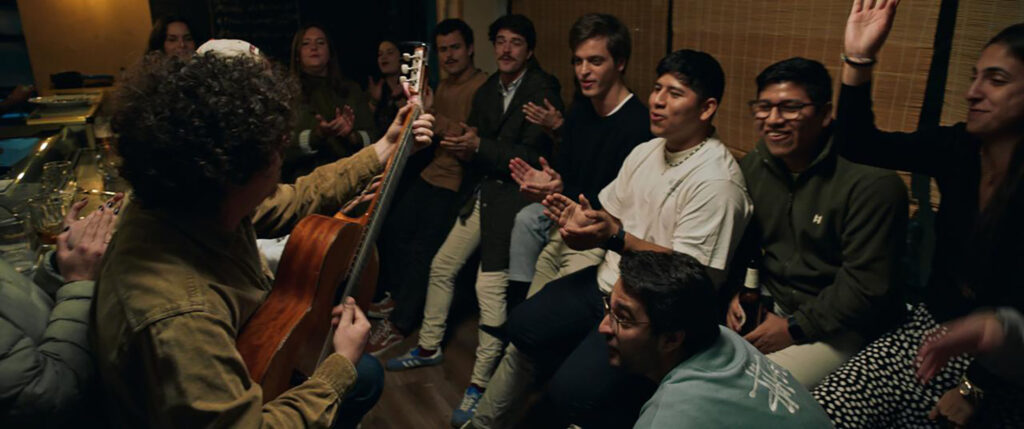
Then, one morning at sunrise, while enjoying his breakfast, he clearly heard these words: ‘I am here!’. And he believed the message. It wasn’t a thought, but an experience, he says in the documentary Descalzos (barefoot, in Spanish) about Hakuna Music Group. ‘Suddenly everything fell into place.’ His wife was baffled and asked him to avoid the subject when being with friends. But Javier insisted: ‘The Holy Spirit tells you to “share it”, and it needs to be shared.’

The Hakuna phenomenon
Javier’s story is just one among thousands. Hakuna Music Group, a group born in the Spanish Church, has caused both an unexpected and baffling upheaval: Catholic music with 541,737 monthly listeners on Spotify and sold-out concerts at the WiZink Centre in Madrid. All this without sophisticated campaigns or segmented strategies.
This success cannot be explained by evangelisation techniques or ‘product design’. There is no committee analysing ‘what works’. What we find in reality is Christian life overflowing into music; songs born of prayer and from the desire to speak to God, incarnated in today’s life.
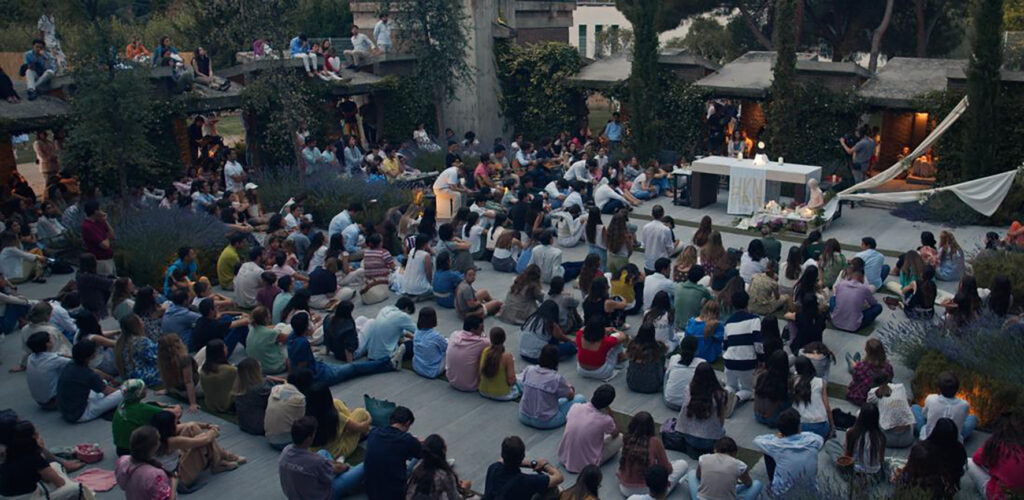
‘The Holy Hours are the centre of everything,’ they say, referring to Eucharistic adoration. It is where their music, their community, and their life are born. Union with Christ makes their work fruitful: the songs are the fruits of this Centre of Life.
‘We don’t write songs for people,’ explains María, one of the voices of the group. ‘The music is born from the desire to talk to God and to show that we are normal young people and, at the same time, Catholics. We express what is inside us.’
‘The music is born from the desire to talk to God and to show that we are normal young people and, at the same time, Catholics. We express what is inside us.’
Herein lies the secret. The evangelisation that takes place around Hakuna is not a method, but a contagion, a spiritual influence that is catching. It does not respond to techniques, but to the truth of life. When what is sung springs up from a real experience of encounter with Christ, that song is alive. And everything alive tends to expand.
The striking light that pleads to be communicated
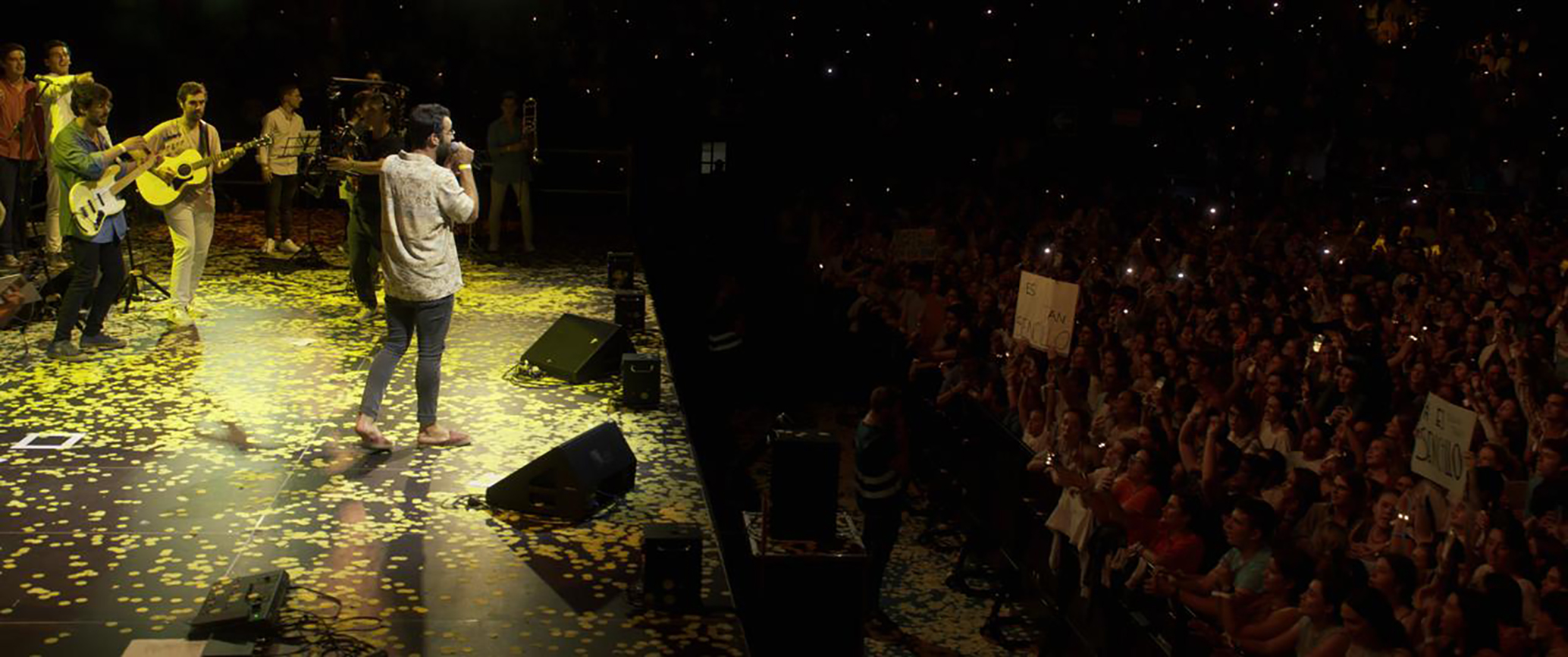
During a Hakuna concert in Vistalegre (Madrid), the sound technicians noticed something surprising. During the song ‘Noche’ (Night), the audience knelt down in silence. Accustomed to thousands of concerts, they felt that ‘something greater than anywhere else was happening there.’ They knelt down too.
A family whose son had been murdered was invited by friends to clear ‘their minds.’ They left not only comforted, but converted, discovering in the Church an unexpected home for their pain.
‘There are people who report that on a specific day, while listening to a song, they find hope or rediscover a longing,’ explains Macarena Torres, Hakuna’s communications manager. ‘There are those who discover more keenly who they are, or what they are called to do.’
What is unique about these stories is not that the music ‘works,’ but that it has a special light, like a small ray that sneaks in without permission and illuminates an area of the heart that was perhaps uninhabited. These songs do not open doors through persuasion; their origin is pure: they are born out of the desire for love, not with the intention to convince. When a song reveals a life touched by God, that song—because of its gratuitousness—leaves room for Someone else.
When that ray touches someone, it urges to be shared. Javier needed to talk about it. Thousands need to share it. Some experiences cannot be contained in silence; they demand to be recounted in words. When words are not enough, they become a song. Thus, a living circle is formed: life with God inspires music, music sparks contagion, and contagion prompts life to flourish again.

them to something greater. Credit: Kenedy-Martins/pexels.
A broader movement
Hakuna is not an isolated phenomenon. It is part of a global movement of contemporary religious music, such as Athens, Tuyo, and others. In the Anglo-Saxon and Protestant world, movements such as Hillsong, Bethel, and Elevation fill stadiums, bringing together tens of thousands of people, and generating a global impact.It is an undeniable sociological fact: millions of people, especially young people, are searching for music that connects them to something greater. This reveals an important fact: faced with either music designed to be a hit regardless of its content or music that is merely functional and empty, many young people are choosing a rather different alternative.
This search for depth is not exclusive to the religious sphere. Singer Rosalía has, for example, explored a mystical vein in her latest works—not confessional, but deeply spiritual—that resonates with this same need. All these quests reveal the same deep need for music that opens up our inner selves, that does not consume us but reunites us with our souls.
The return to the sacred
Historically, music in the West was born and developed in the realm of ritual. For centuries, the most elaborate music was reserved for the liturgy. Gregorian chant, Renaissance polyphony, the great Baroque masses: the entire Western musical tradition has its roots in the sacred.
This is no coincidence. The sacred is, by definition, a space separate from the everyday world, a place where everything has value in itself and not because of its usefulness. In that space, singing is not anecdotal but essential. Praise and liturgy naturally call for singing. Perhaps singing has its ultimate purpose there.
Millions of people, especially young people, are searching for music that connects them to something greater.
Over time, music became separated from its ritual origins, secularised, and autonomous. This in itself was not a drawback: it produced masterpieces that explore the full range of human experience. However, something was lost. Music increasingly became entertainment, a product, a tool. Now, in the midst of our digital age, when music is more accessible but also more functional than ever, we are seeing something unexpected: a certain movement of return. As if the very nature of music is reclaiming its place.
The interesting thing is that people are once more eager to sing, but in different ways: to convey their spiritual life with flesh, sensitivity, and current dynamics. These are the same universal essential quests — for meaning, beauty, transcendence — but with new names, sounds, and forms. While this music does not renounce contemporaneity, it also does not disavow the transcendent.
The paradox of the useless
The philosopher Josef Pieper devoted much of his work to defending a concept almost revolutionary in our time: the perspective that there are human activities that do not need to justify their existence by their usefulness. Music, art, celebration, contemplation… all these are only possible because human beings are capable of slowing down and regarding life gratuitously. For Pieper, contemplating is not analysing or thinking about something: it is looking with love, saying to reality, “how good it is that you exist”.
This is the source of the purest music: the celebration of being, not calculation. It does not seek to produce a particular effect; it offers itself as a lavish display of existence.
We carry within us a longing for infinity, that we are made for song and for gratuitousness.
And Pieper goes even further: at the heart of reality—according to Christian tradition— God is eternally pronouncing over each creature that same ‘how good it is that you exist’. All creation springs from this gratuitousness, out of love. When music is born from that same source — when it does not seek to convince, or serve any purpose — it participates in the spirit of that creative love.
That is why ‘useless’ music reminds us of our spiritual condition. It restores this primary dignity to us: to participate in a greater Love. It allows us to experience our lives and the world as existence, which is celebratory for the simple fact of existing. It involves entering a realm of complete freedom, where we do not simply have to produce and consume, but may love freely, contemplate, and sing ‘just for the sake of it.’ That, paradoxically, is what makes us deeply human.

Singing what we live and recovering what is human
What is happening with Hakuna is more than a cultural phenomenon. It is the transmission of spiritual life, spreading conversions to the love of God, born not from strategies, but from the purest gratuitousness: singing what we pray and sharing what we live.
When God is at the centre — in the Holy Hours, in silent adoration, in contemplation — something occurs. That encounter moves us towards a certain realm of unconditionality, of the “useless” that needs no justification.
Perhaps that is why thousands of young people fill stadiums to listen to explicitly religious songs in a secular age. Deep down, they recognise that music which serves no necessarily useful purpose is what best reminds us of who we are. That we are spirit, that we carry within us a longing for infinity, that we are made for song and for gratuitousness.
A Sacred Bridge Between Earth and Heaven
The author makes us aware that music is paramount to Afro-ethnicity. It leads African people collectively to God; music embodies every step of their lives with its joys and hardships. Music calls for participation, it is therapeutic, and conveys the strength for liberation from any kind of oppression.