
MUSIC AND SPIRITUALITY
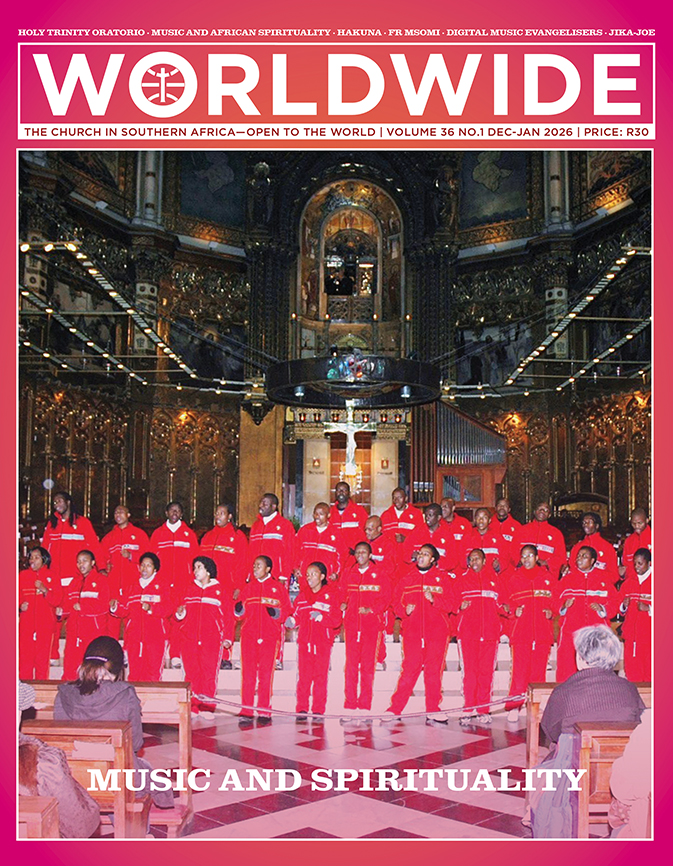
The choir Izwi le Themba (voices of hope in isiZulu) from Saint Daniel Comboni Parish at Mahube Valley, Mameldi, Pretoria, singing at Montserrat Abbey in Barcelona, during their concert tour to Spain in 2008. The group’s name conveys a deep meaning rooted in one of the reasons for singing: to bring hope to the world.
Credit: Fr James Calvera MCCJ.
PROFILE • FR SBONGISENI JOSEPH MSOMI
Music, a reminder of the lost paradise
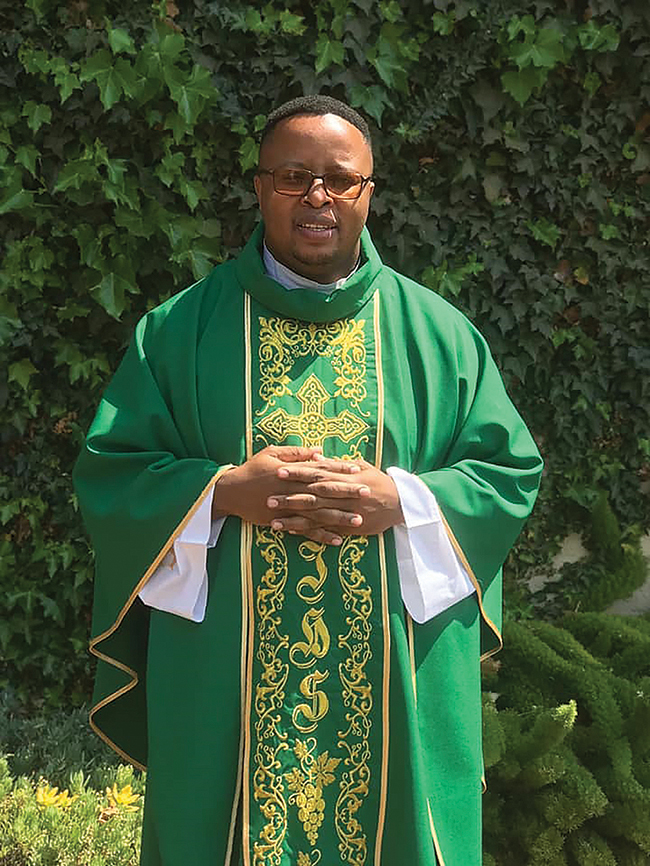
Dean of Studies at St. John Vianney Seminary in Pretoria, Fr Msomi uses his rich musical talents to serve in evangelization. Passionate about music’s power to unite people, bring us closer to God, and connect us to the best African traditions, Fr Msomi composes and records songs that, from South Africa, carry a voice of hope for the world.
BY MARIAN PALLISTER | CHAIR OF PAX CHRISTI SCOTLAND
PHOTOS AND VIDEOS BY FR SBONGISENI JOSEPH MSOMI
WE LIVE in troubled times—but then, for some parts of the world, including the Middle East, DR Congo, areas on the Pacific Rim, and South Africa, troubled times have too often been the norm.
Encouraging, then, that when glimmers of hope break through, music is often the first evidence that there can be life after tragedy, normality after the disruption of political upheaval. Even though a ceasefire in the Holy Land proves very fragile, social media posts soon focused on kids breakdancing or singing traditional songs.
“Music offers an element of joy and an aspect of being touched by the very message you are communicating when you sing”. (Fr Msomi).
I remember meeting refugees from DR Congo in Kenya some years ago and being deeply moved by the fact that they met every Sunday in a dilapidated hall, to play a very worn cassette to which they sang, danced, and taught their children traditional songs. They said music boosted their mental health and gave them hope.
All this came to mind when I recently spoke to Fr Sbongiseni Joseph Msomi, South African musician, conductor, and composer, who believes that music unites communities, enables them to speak with one voice, and creates space for hope.
Music: A faithful companion
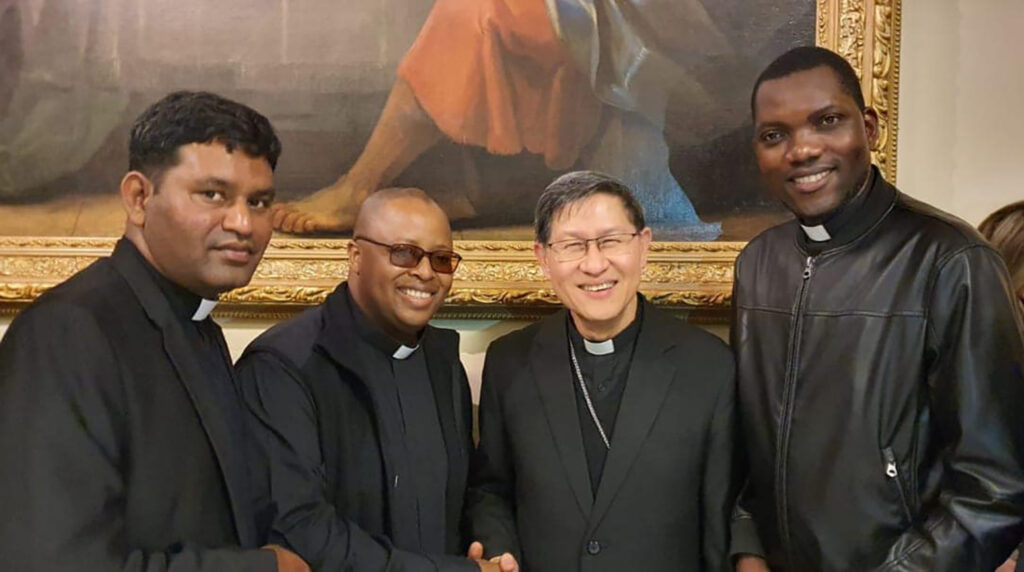
Fr Msomi, who teaches at the St John Vianney Seminary in Pretoria, doesn’t remember a time when there was no music in his life— at home, in primary and secondary school, in church, at university in Durban, and during his own training to become a priest, in Rome and in South Africa.
Home was KwaMakhutha township in KwaZulu-Natal, where he went to the local comprehensive high school. He recalls that his mother and grandmother were Catholics, and growing up in that Catholic family with music at home and in the church, he was immersed from an early age. He sang in the church choir as a young child, and says his high school conductor, Mr Khathi, encouraged him to join the school choir. He went on to study electrical engineering for two years in Durban and joined the ML Sultan Technikon Choir as a tenor. On the home front, he became a member of the Ezimbokodweni Community Choir in KwaMakhutha, which assisted the Anglican church choir when they were preparing for competitions.
He found himself conducting a choir in the Anglican National Choir Competition and modestly recalls that his choir won that contest on a national level for two years running. Fr Msomi also conducted the Ezimbokodweni Adult Choir in KwaZulu-Natal competitions, and once ordained as a priest, he became involved in the diocesan committee of choirs in Mariannhill, preparing the diocesan annual Festival of St Cecilia.
Composer
It was, however, while he was still a seminarian that he began composing seriously. He had produced some work with the Ezimbokodweni Choir, but he says, “This developed further in the seminary, thanks to the organ course that we attended for three years.” That was the first formal music ‘education’ that he received, but by then, with his newly acquired skills in reading music, and his ever-growing love of music, he was all set not only to write what was in his heart, but also to record.
“With music, God has left people with the memory of paradise lost.” (Hildegard von Bingen).
Fr Msomi says, “I learned from researching and from others,” and he is quick to give credit for his own skills to the example of professionals who conducted at church, at school, and the choirs he would join later.
When he started conducting, especially at competitions, he researched how to teach the choir members—this was clearly successful, as evidenced by the list of first-place finishes.
Music, he says, offers “an element of joy and an aspect of being touched by the very message you are communicating when you sing”. He first felt that music communicated a spirituality to him when he listened as a child to his parish priest chanting all the parts of the Mass. And, he adds, music helps us to relax, to be formed “by the very message in a hymn or a classical song or an operatic aria. The composer is always communicating a message”.
Fr Msomi explains that at an early age he developed the skill of writing music, which he says allowed him to communicate something to the singers and to those listening. “When you compose, it is not just a melody — you are communicating something.”
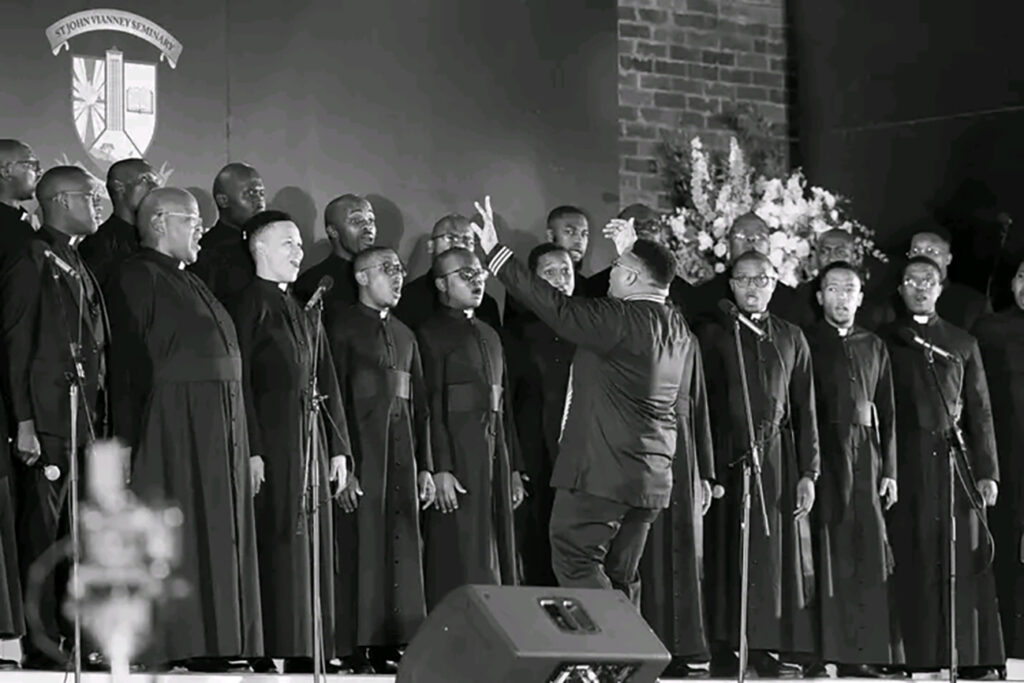
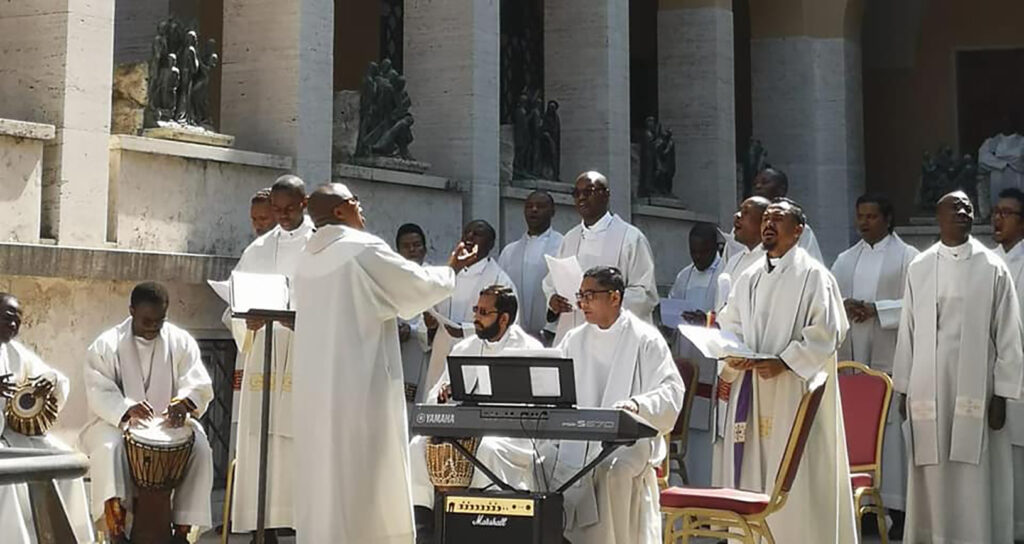
and the Launch of the Missa St John Vianney, at Regina Mundi Parish, Soweto.
Divine footprints
He appreciates Hildegard von Bingen’s ideas about music. The 12th-century German composer is quoted as saying, “With music, God has left people with the memory of paradise lost.” He smiles and states, “Music is a gift from God,” thinking of his time in Rome, when he found himself singing with people from China and Vietnam. He says, “Music united us. It was something we could use to communicate among ourselves; so it is a gift, there is some form of spirituality there, and maybe God wants us to really reach out to others pastorally and use us through this gift, which is music, because music is also a language.”
“Music is a medicine for all. It brings hope. At that time, singing lifted our spirits.” (Fr Msomi).
Fr Msomi was in Rome during the COVID outbreak and recalls that the fathers in the college would meet up and sing, an opportunity which became a moment of renewal and healing in the challenging time of lockdown.
He adds, “Music is a medicine for all. It brings hope. At that time, singing lifted our spirits, so Augustine is right when he says that ‘whosoever sings well prays twice’.”
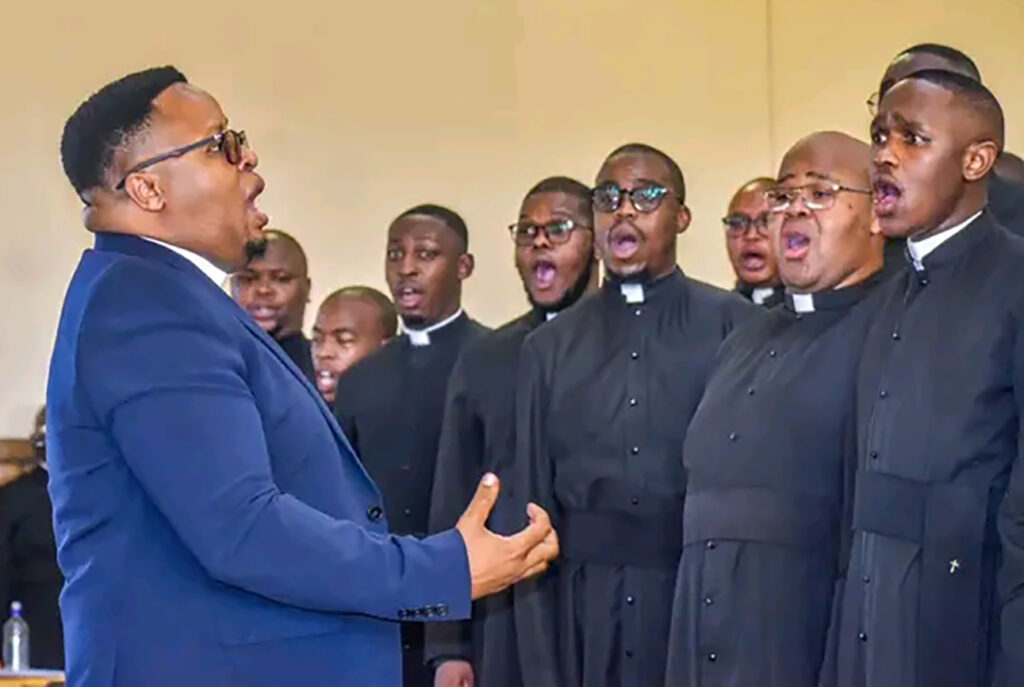
St Joseph
These days, his composing focuses on liturgical parts of Mass. A recent Mass he wrote was dedicated to St Joseph the Worker. He smiles and says, “Mainly because I am Joseph,” adding, “but also when I look at my life when I was growing up, all parents went out to work in the morning so that they could put food on the table, so there was some element of Joseph the Worker there and I wanted to compose and dedicate that Mass to those kind of people—and also because when we were growing up, many of the people who introduced us to the Church were working so hard to feed their own children.”
Fr Msomi has many claims on his schedule. He not only teaches at the seminary but is the academic dean. He still finds time to teach music to the students, to conduct, and to compose. And he smiles again when he says that perhaps this interview for Worldwide is a call for him to record another album. His first was in 2021, and it showcased some of his compositions that were intended to contribute to liturgical formation: how we should sing hymns and parts of the Mass.
He has written much since then, including some works in Italian, which he composed when he was working in Ischia. He says they were inspired by the local choir during COVID. “They were very committed,” he says.
He is also working on compositions in some of the various South African languages with the intention of reaching out to the wider communities. “I’m a recording artist and not necessarily a performing artist,” he says. “I record for the sake of evangelisation.”
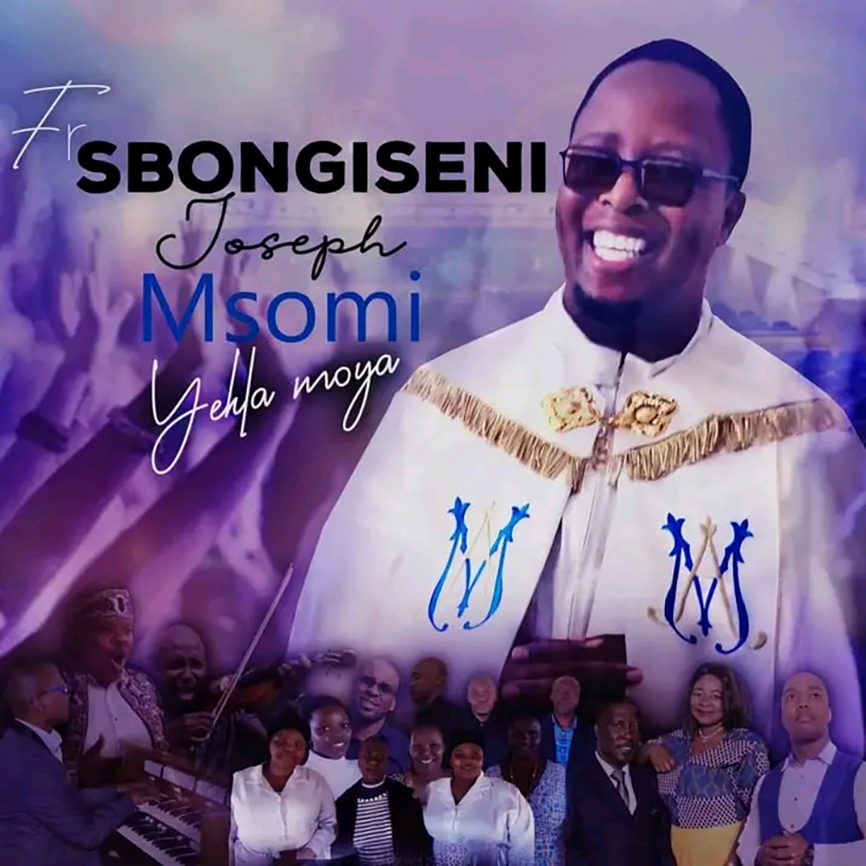
“Love Yourself”
Although much of his work is liturgical, he was approached by a school that wanted him to write something that would speak to the children. He responded with a song that emphasised self-acceptance. “Accepting who you are, with your skin, with your culture,” he explains. It was entitled “Love Yourself”. It combined choral music, traditional music, and dance, as he wanted to return to African roots. By “African roots,” Fr Msomi says he means “respect, respecting the elders, and what the elders teach.” He adds, “There is that element of advocating for Africanism and also for spiritual songs in general.”
One of the choral works he has composed for male voices is entitled “Don’t lose hope”. It is in English and Zulu, and he says, “It goes as far as saying never give up.”
His contribution to music includes presenting concerts, bringing spiritual music to different parishes. That exposure of what people in South Africa are feeling in these troubled times has been insightful. With the country speaking out on the international stage about the form of apartheid imposed on Palestine, and its demands for the International Court of Justice to act on Palestine’s behalf, Fr Msomi says, “With digital technology, people are now exposed to what is happening in the world, and that itself is important. There is a feeling that South Africa should be listened to and that South Africa should have a voice.”
South African voice of hope
He adds, “Not only South Africa but also the Church in South Africa should have a voice locally but also abroad. What I am seeing is that there is a need for a formation on how to use digital media. When there is no formation, it can be misused or abused. Not all information from the media is accurate.”
That having been said, Fr Msomi is clear that South Africa should be heard and should respond to international problems. He is convinced that in this Year of Hope, designated as such by Pope Francis, “There is room for hope.”
“Music plays a role as a sign of hope in the sense that it unites us, in that it enables us to speak with one voice”. (Fr Msomi).
Signs of hope, he says, include the growing choral movement with choirs comprising all age groups. Competitions and musical performances are flourishing in South Africa, not only with choral music but also with indigenous music. There are signs of hope, he adds, in the fact that there are still young people joining seminaries, that we are still invited to weddings, and that people are yearning for authentic families within the sacrament of marriage. The fact that there are teachers, nurses, and doctors who wake up in the morning, “giving themselves wholeheartedly and lovingly” to serving people, is also a sign of hope. That there are still organisations assisting the poor is a sign of hope. “That there are still people who are giving and who want to see others smiling — that is a sign of hope. We must just be open to it.”
He adds that Christ becomes central to that hope, and music then plays a role as a sign of hope “in the sense that it unites us, in that it enables us to speak with one voice”. We are fortunate that Fr Msomi’s music is the soundtrack to these signs of hope that he lists with such warmth.
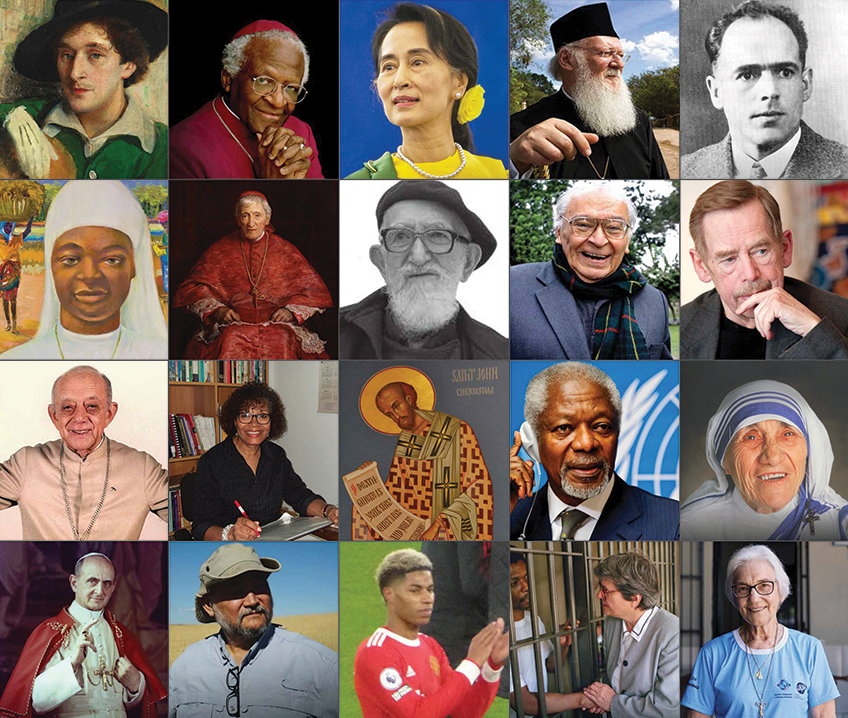
BEACONS FOR A NEW HUMANITY
ONE OF THE aspects of journalism that I enjoy most is the element of surprise. Every new assignment brings a frisson of excitement: you just don’t know how it will pan out. Writing profiles for Worldwide since 2016 has brought both excitement and surprise.