
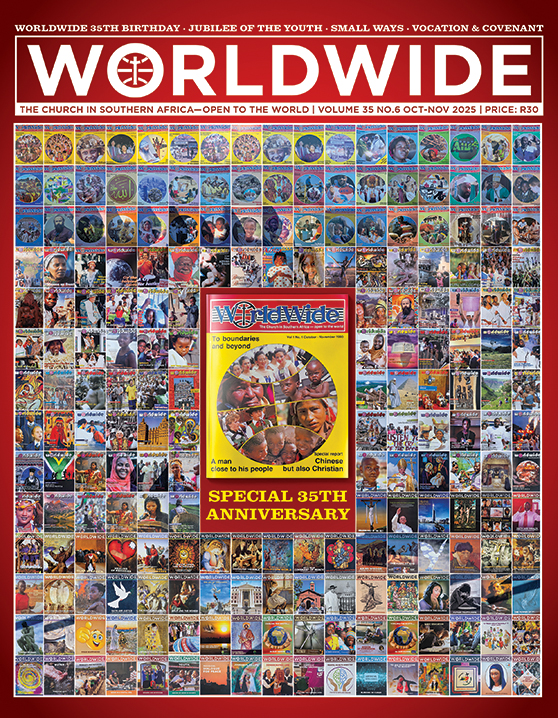
This collage features the front covers of Worldwide issues over its 35 years of existence. At the centre is the cover of the first edition, dated October/November 1990. Worldwide saw the light during a missionary month and continues its mission of proclaiming the Gospel; this is the reason for its being.
Credit: Worldwide archives.
For more than twenty-five years, Mike Poithier has enriched Worldwide with his insightful columns about the most relevant issues in the life of South Africa. As he says, some of these issues are still unresolved, while others, which he mentions in this piece, make this country proud of its potential and values.
INSIGHTS
LOOKING BACK…
BY Mike Pothier | Programme Manager, SACBC Parliamentary Liaison Office, Cape Town
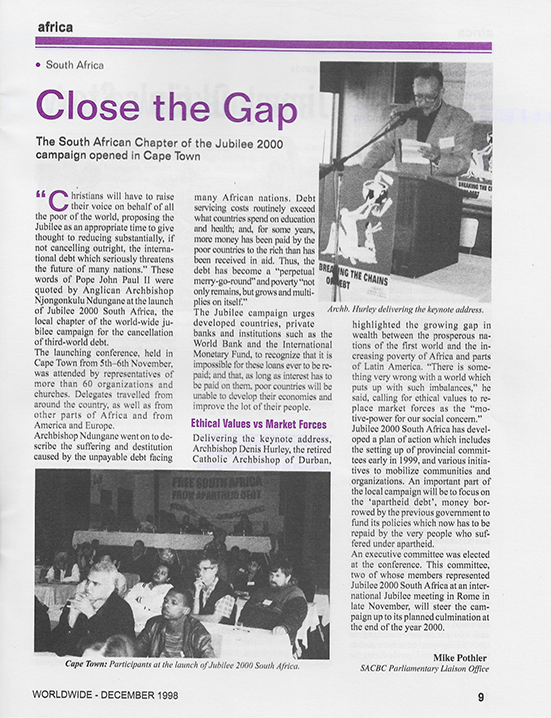
AS FAR AS I can tell, my first column for Worldwide was for the December 1998/January 1999 issue. It was a report about the South African launch of the Jubilee 2000 campaign, which called for the cancellation of developing-world debt. It is perhaps fitting, therefore, that this opportunity to reflect on Worldwide’s wonderful 35 years of publication comes in the middle of the 2025 ‘Pilgrims of Hope’ Jubilee year.
Looking back at the columns I wrote at the end of the 1990s—the end of the last century! — it is striking how many of the important themes then are still with us. For example, in February/March 1999, I wrote about the arms deal, one of democratic South Africa’s first major policy mistakes. Much of what we bought then has never been used and is now inoperative, as our defense force deteriorates slowly but steadily. And, amazingly, the corruption allegations against Jacob Zuma that had their origins in the arms deal are still winding their way agonizingly through the courts!
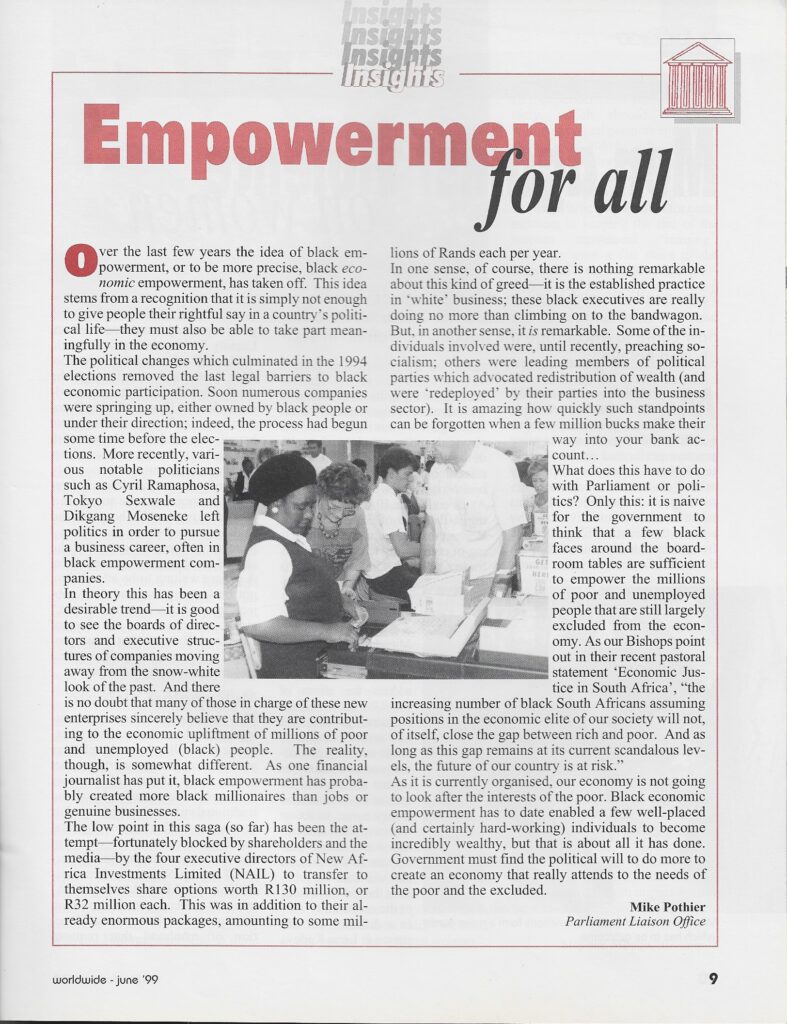
In June of that year, I looked at Black Economic Empowerment, making the point that while it “had enabled a few well-placed individuals to become incredibly wealthy… Government must find the political will to do more to create an economy that really attends to the needs of the poor and the excluded.” That is still the case, and the debate around the effectiveness of BEE and other forms of affirmative action is as heated and urgent now as it was then.
The next column was titled “When Politicians Lie!”—well, let’s just say that that problem hasn’t exactly disappeared. In June 2000, the subject was land, and the fact that, six years into democracy, “very few people whom apartheid wrenched from their homes and suburbs have got them back.” That, too, hasn’t changed much in the intervening 25 years.
But it’s not by any means only a case of unresolved problems and ‘same old, same old’. In 2002, I wrote about the power of civil society, following the Treatment Action Campaign’s success in forcing a turnaround in the government’s policy against the provision of anti-HIV treatment to pregnant women and their children. The enormous influence of civil society is a theme that I often return to, and it remains one of our country’s shining lights.
Another significant achievement is our history of free, fair, and well-organized elections. I wrote about this in the lead-up to the 2004 national elections: “It is only through a vibrant and committed electorate that democratic government can be preserved.” We should never underestimate the importance of our record of genuinely democratic elections and the opportunity they provide to shape the direction and future of our country.
Interestingly, most of what I have written about in nearly 150 columns concerns the ordinary ups and downs of a democracy—new laws, both good and bad; constitutional issues; government’s frequent failures and occasional successes; the ever-present problems of corruption and patronage politics; and some politicians who, by truly serving the nation, live up to Pope Francis’s remark that “politics is a noble profession”, as well as others who serve only themselves.
The enormous influence of civil society is a theme that I often return to, and it remains one of our country’s shining lights.
I take comfort from this normality. Even if we have not succeeded in resolving our most pressing issues, and even if in some sense we have wasted much time and energy, we remain a working democracy. The people of South Africa retain the ability to choose who will lead them and to get rid of those who have failed them. At a time in history when democracies all over the world are facing both internal and external threats, we have a lot to be proud of.
Worldwide began publication in 1990, the year that saw the unbanning of the liberation movements, the release of the political prisoners, and the start of moves towards freedom and democracy. The magazine has accompanied us on the long journey since then, recording it and commenting on it through the lens of Christian values. While my columns have focused almost exclusively on South Africa, the magazine has covered a much wider arc, with a strong emphasis on Southern Africa, the continent as a whole, and even other parts of the developing world.
All of us who take an interest in these matters, and who seek to understand them from a Christian and Catholic point of view, owe a great debt to Worldwide and to the Comboni Family for keeping it going for 35 years—long may it continue to inform us and to open Africa to us.
Churches of the Global South call for climate justice and protection of our common home
The contested discussion around statelessness, according to the author of this article, seems to be very well captured in the words of Abdul Ahad Khan Sulayman: “A stateless person is like the wingless bird. It has the capacity to fly but doesn’t have the wings to fly.”