

YOUTH AND JUBILEE
The front cover portrays faces of various youth leaders from the parish of Regina Mundi in Soweto. This parish played a significant role during the 1976 uprisings, protecting those who took refuge in its shelter. Nearly 50 years later, these young men and women represent the hope for a better South Africa, where youth can exercise a meaningful role in society and in the Church, where their talents can be recognized and their voices heard. May their dreams for a bright future and a fruitful discipleship of Jesus be fulfilled.
FRONTIERS • CENTRAL AFRICAN REPUBLIC
FRESH IMPRESSIONS FROM A NEW MISSION
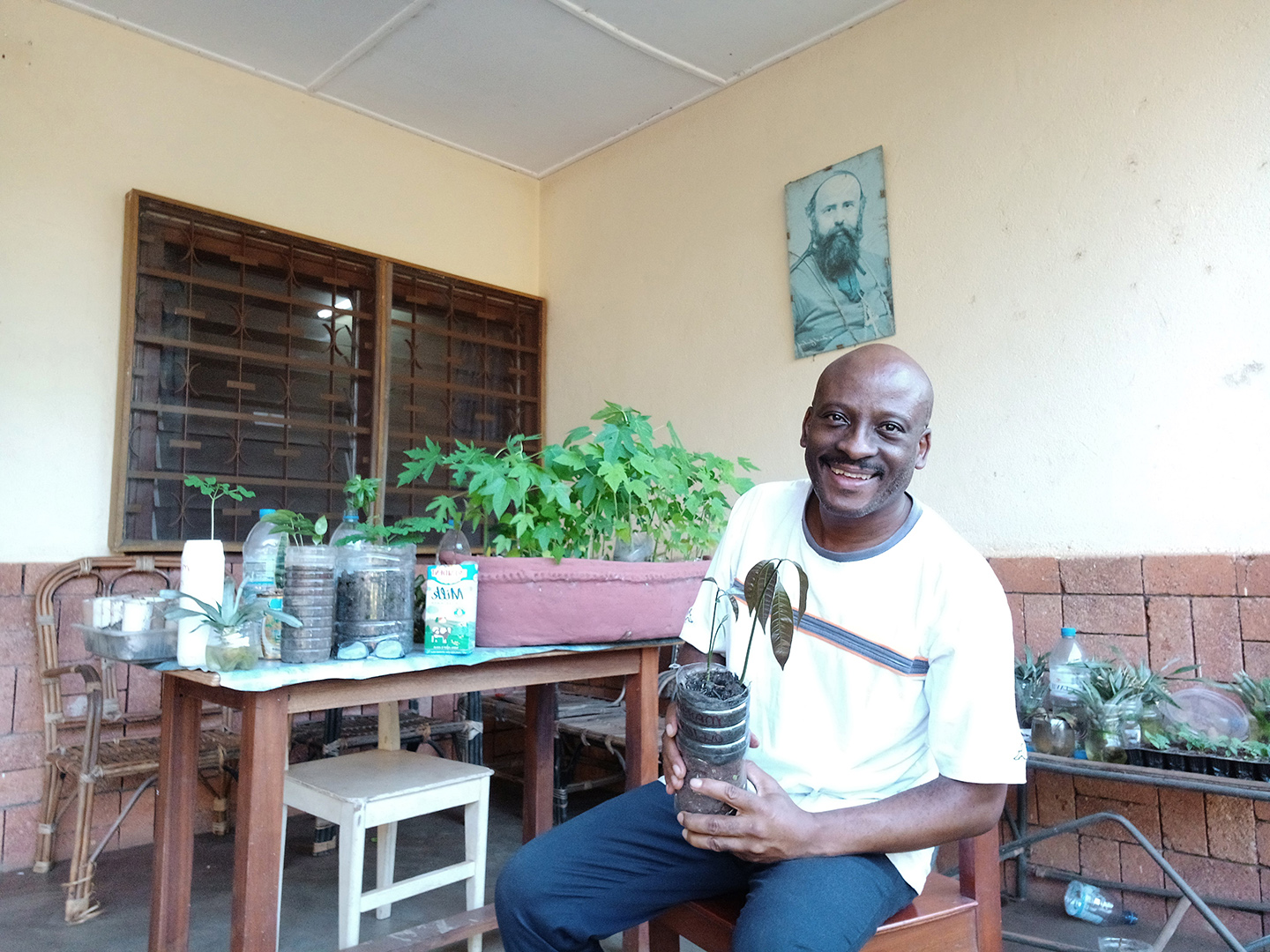
Fr Kgomotso Sebopela is a young Comboni missionary from Mabopane, Pretoria. He worked in Chad for some years and then, once back at home, in Orange Farm, Johannesburg. During these first months in the Central African Republic, he narrates the reality of the Church in this country and speaks out about his personal thoughts on what missionary life is all about.
BY FR KGOMOTSO SEBOPELA MCCJ | BANGUI, CENTRAL AFRICAN REPUBLIC
MY INSPIRATION to travel and see the world has always been that of St Paul, and I thank the Holy Spirit for this grace. St Paul’s missionary zeal has always amazed me. He listened to the Gospel and felt the need to go out and proclaim it in distant places. St Daniel Comboni was just as brave. I have read, listened to and witnessed stories of many fearless missionaries who all gave me the courage to continue their spiritual legacy.
While exploring the country Sudan, in the mid-19th century, Comboni wrote to his cousin Eustachio: “They travel on foot, canoes, camels and ships as means to preach the Gospel for the sake of the divine providence” (WDC 314).
Here I find myself today, continuing the very same mission of SS Paul and Comboni as well as many other missionaries who lived before me. When I address young men in Vocation Workshops, I tell them of the hardships which encompass missionary life. Unfortunately, many young people, especially in developing countries, enter seminaries or join religious congregations with the hope of enjoying a future comfortable life, which appears more like a career than a graceful call to serve the needs of Mother Church. This will eventually cause the Church to fail in her mission of spreading the gospel. Missionaries are in fact sent out to suffer their fate. The Gospel we preach came to us through missionaries who toiled to share the message of salvation. The need to spread the Gospel is as relevant today as it was two millennia ago. The local Church that sends out missionaries shows signs of maturity rather than of a faith which is stagnating. Missionaries are responding to Jesus’ command: ‘Go into all the world and proclaim the Gospel to the whole creation’ (Mk 16:15).
The Church in the Central African Republic
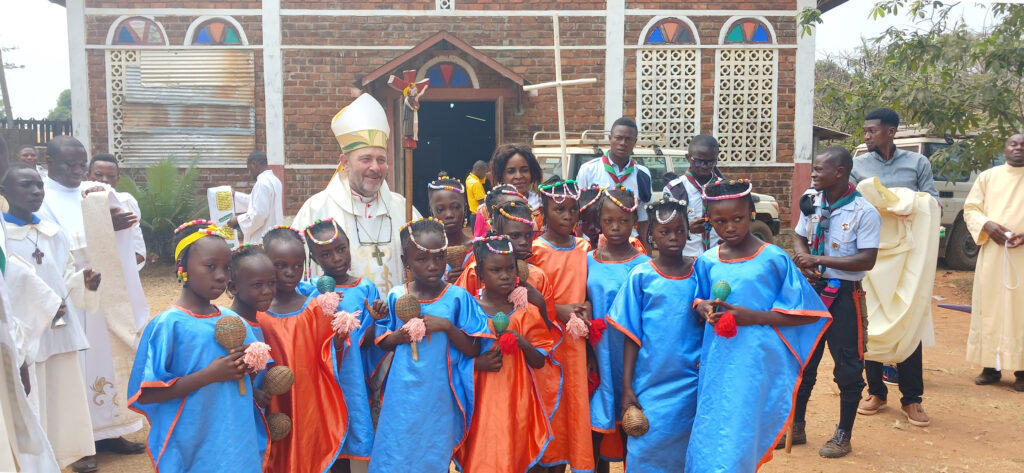
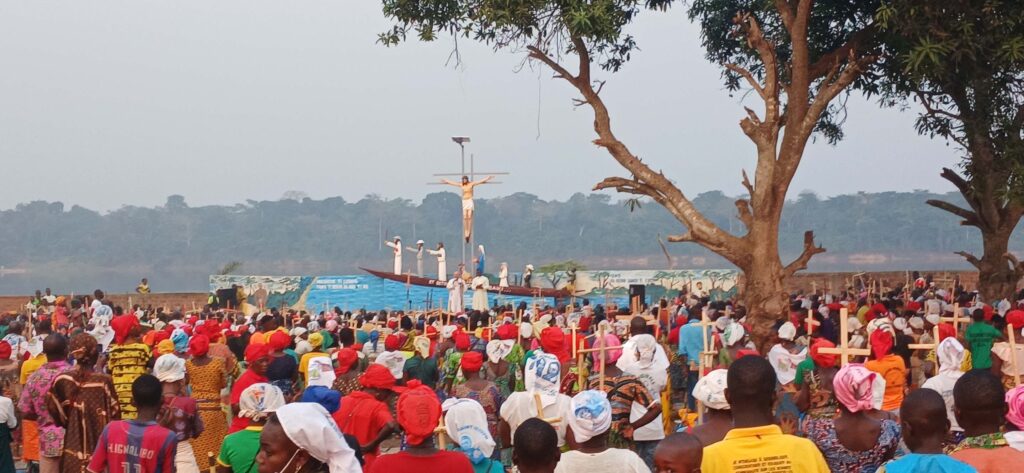
It is only recently that the Church in the Central African Republic (CAR) celebrated her 100 years of Evangelization. The first group of French Spiritans arrived in this land from Congo Brazzaville in 1893. The Diocese of Mbaiki, where I attended the centenary celebrations at the end of January 2025, erected a monument for the first missionaries who arrived from Brazzaville, sailing on the Lobaye River. It was a great occasion; some of the members of the National Assembly even came to witness this great historical event.
The first group of Comboni Missionaries came from Sudan in 1964, after having been expelled by the Government. This became a moment of grace for the already present Spiritans, who were exhausted by attending to the steadily growing number of Christians. Today both congregations work hand in hand with other religious groups such as the Society of African Missions, the Jesuits, the Dominicans, etc. Moreover, there are also many young and dedicated Fidei Donum Priests and Lay people from Poland, Spain and neighbouring countries. The Church in the CAR is prospering and flourishing and full of life; her future looks bright in the light of the booming vocations.
Mission in CAR
I arrived in the Central African Republic on the night of the 11th of January 2025. Even at 10 pm, the city appeared as if it was just awakening. Many commercial activities were distinguishable: street vendors, open taverns, trucks moving, and many taxi motorcycles in full action. The streets of the city are well lit with solar lights. The presence of United Nations vehicles cannot be ignored. It has been almost nine years since the war ended, and because of its recentness, the trauma that the poverty-stricken people suffered during the war is still tangible. Therefore, the Central Africans try by all means to avoid any personal conflicts and confrontations. Though poverty is evident, one can see that on daily basis people are striving to survive, even with limited resources. There is an imposed curfew at 10 pm for all UN vehicles and personnel, but city dwellers prefer to abide by it as well.
The local Church that sends out missionaries shows signs of maturity rather than of a faith which is stagnating.
The Church in the CAR is led by Cardinal Dieudonne Nzapalainga. The faith of the Catholic population is very strong. They trust those who preach the Gospel. Lay Catholics are very active in their apostolate. Small Christian Communities gather to pray daily. Central Africa is a fertile ground for the expansion of Christianity, faith being its major source of growth. The use of Sango, the local language, official in Government documents, plays a significant role too. Originally, a language of trade, it is now also used in the liturgy. It is spoken and understood by most of the population, making it easy to communicate and preach the Gospel across the nation.
Basic education and primary healthcare remain challenges, as in many African countries. However, the Church, by means of her personnel and structures, such as Charitas, plays a vital role in assisting those in isolated villages to sustain themselves.
Climate change
The effects of climate change cannot be ignored either. Rains are not constant, and the heat is intense, making it difficult for farmers to maintain a normal agricultural rhythm. Some NGO’S as well as the World Food Programme are trying by all means possible to assist these farmers but more needs to be done. Simultaneously, one cannot ignore the issue of large trucks transporting massive tree trunks. Tree trunks, which reach the size of train coaches, are seen being exported out of the country daily. These trees may have taken thousands of years to mature, and they are not being replaced. Deforestation is a huge problem, not only reducing oxygen levels, but depriving human groups—such as the pygmies—as well as many rare animal species, of their livelihood and home.
All these facts made me think of alternative ways of preaching the Gospel of Jesus, while reading the signs of our times. I began by saving seeds from every type of fruit which I ate. Within three months of my arrival, as a hobby in my spare time, I had created a little forest of avocadoes, papaws, apples, custard fruit, pitanga, mangoes, a variety of citrus fruits and pineapples. Thanks to a warm tropical climate and the ever-fertile soil of Central Africa, seeds germinate quickly and vigorously. Through God’s grace, I hope to gather more disciples who will contribute to the curbing of hunger and the healing of our planet, reversing the adverse effects of global warming.
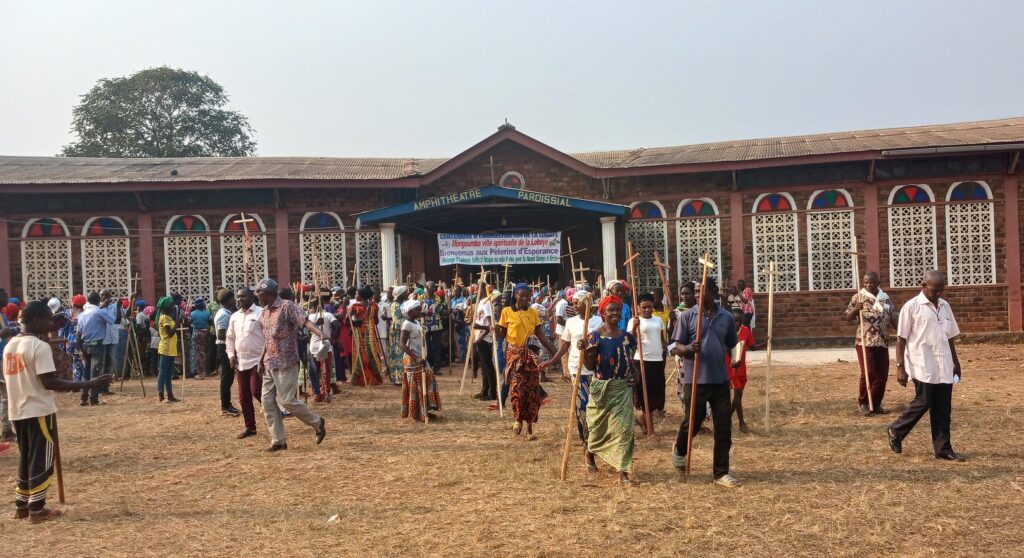
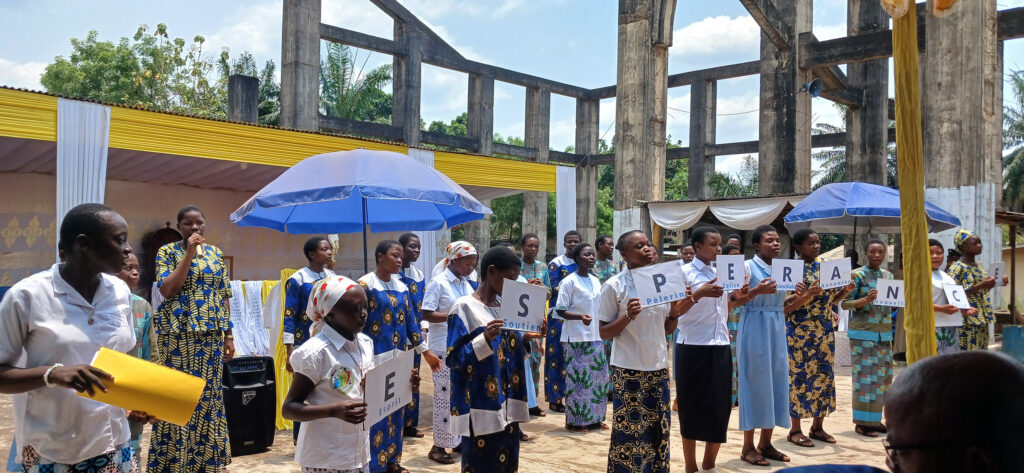
I feel proud to be working as a Comboni missionary in the CAR. I have witnessed all kinds of developments in infrastructure: the Solar Revolution, the construction of the Trans-Africa Highway; in terms of Spiritual Growth: positive courage and dedication of young missionaries, booming vocations, and the growing number of small Christian communities.
Life of the youth
The Church in Central Africa looks forward to a brighter future. However, self-sustenance is something which African Christians need to learn more about. People need to learn how to manufacture their own bricks and build their own schools and churches.
Within three months of my arrival, I had created a little forest of avocadoes, papaws, apples, custard fruit, pitanga, mangoes, a variety of citrus fruits and pineapples.
The youth in the CAR respect the Church and her personnel. They appreciate the Sacred Liturgy and understand the importance of the presence of Blessed Sacrament. In other countries, we nowadays hear and see young people staging protests inside Churches. This defiles the Blessed Sacrament and it does not happen in the CAR. Elderly people, particularly old men, are seen as strong disciplinarians and their word is taken seriously. They are not feared but are deeply respected by both the clergy and lay people because of the role they play in society. Instead, it seems that in some countries there is a huge breakdown between older and younger generations in families. The State and the Church are unable to restore the moral order and to enhance the spiritual lives of the youth.
I pray and hope that this Jubilee Year of Hope will change and convert many hearts towards love for the Mother Church and that one day, in the same way as we celebrate World Youth Day, the Eucharistic Congress and other special days, we will celebrate a Missionary Congress Day too. Hope never disappoints.
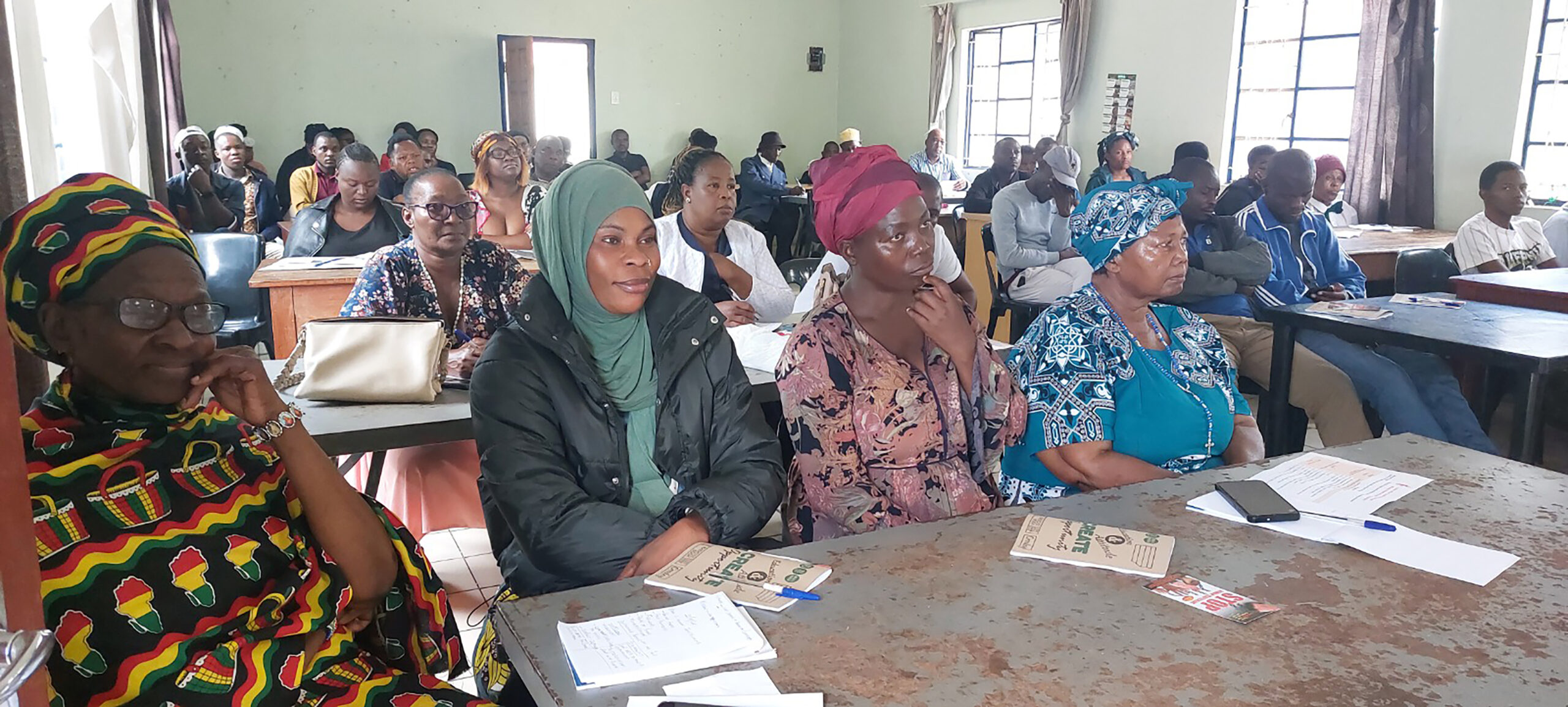
HIGHLIGHTING THE ENDURING PLIGHT OF REFUGEE MOTHERS IN SA: HOW THE CHURCH STEPS IN
Africa Day is celebrated on May 25th. The author focuses on the reality of thousands of refugee women who, fleeing from various conflicts or having been victims of trafficking, courageously strive to find a home in South Africa. The Church responds actively to their need for integration into society.