
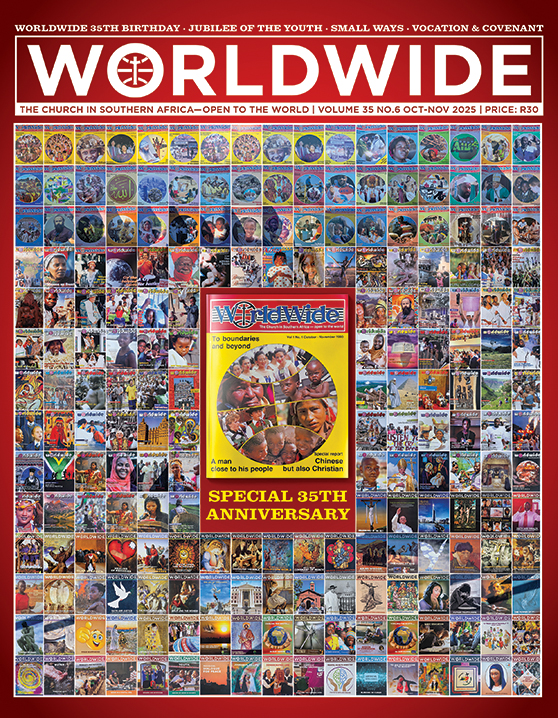
This collage features the front covers of Worldwide issues over its 35 years of existence. At the centre is the cover of the first edition, dated October/November 1990. Worldwide saw the light during a missionary month and continues its mission of proclaiming the Gospel; this is the reason for its being.
Credit: Worldwide archives.
RADAR
THE ARCHDIOCESE OF PRETORIA MARKS ITS JUBILEE OF HOPE WITH RECORD ATTENDANCE
BY Fr Mathibela Sebothoma | GARANKUWA, PRETORIA
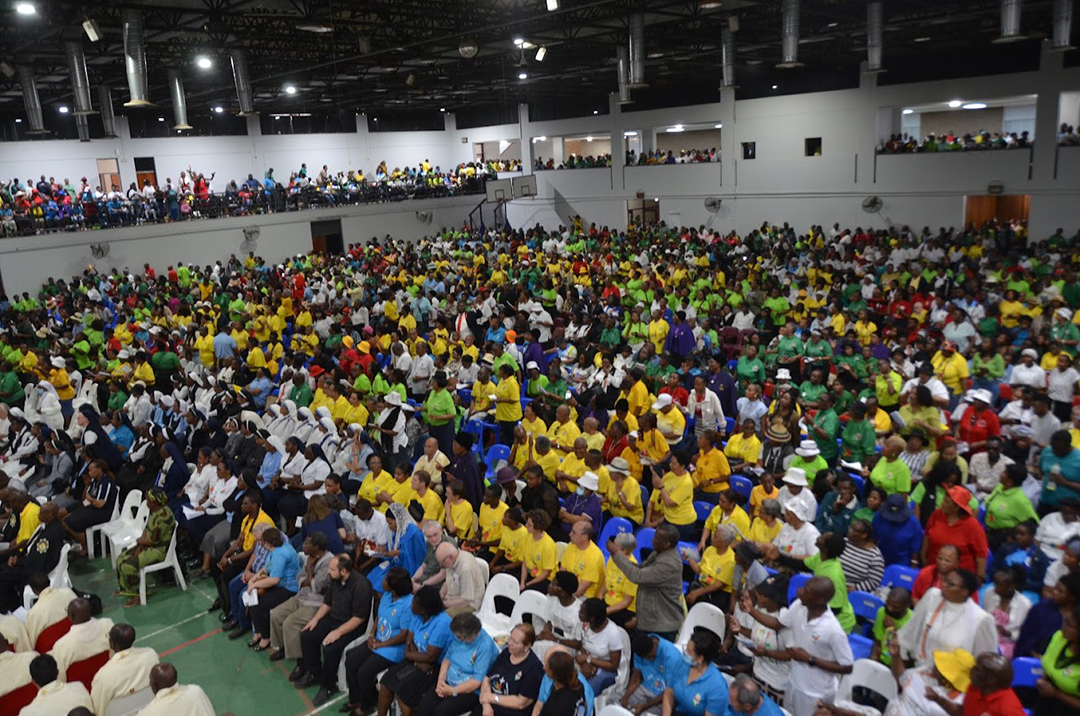
AROUND 6 000 PILGRIMS from all over Pretoria gathered for the Archdiocese’s Jubilee of Hope celebration at the Sefako Makgatho Health Sciences University on Sunday, 14 September. The sports hall, used for the liturgy, was overcrowded, and many had to sit on the lawns outside.
The sight was striking: members of parishes and deaneries arriving in buses, taxis, and private cars; choirs rehearsing; and parishioners wearing different colourful Jubilee t-shirts, designed for the occasion.
It was the first time in many years that the Archdiocese recorded such a large turnout for a single pilgrimage. Organisers described it as “a moment of grace and renewal” and “a sign that the people of Pretoria are indeed pilgrims of hope.”
The celebration commenced with the ceremony of the blessing of the Jubilee Door, symbolising a renewed entry into the life of Christ. The Archdiocese’s Youth Ministry led the rite vibrantly, reminding the faithful that young people are at the heart of the Church’s journey of faith. A solemn procession with the Jubilee Cross, while reciting the Rosary, followed through the grounds. The Cross, carried by representatives from different parishes, became a visible sign of unity.
As hundreds queued for the Sacrament of Reconciliation, Bishop John Masilo Selemela addressed the faithful under the theme “In Hope We Are Saved.” His reflection drew deeply from Pope Benedict XVI’s encyclical Spe Salvi and Pope Francis’ Jubilee theme “Pilgrims of Hope.”
“Hope,” Bishop Selemela stated, “is not an empty word or a feeling. It is a power that changes how we live. Hope gives us the courage to face life’s difficulties, because we know they are not the end. There is always more—God has promised us eternal life.”
He reminded the congregation that hope is never separated from suffering. “If we try to escape suffering, we end up with a hollow life, but when we unite our pain with Christ’s suffering, we find meaning and we grow spiritually,” he mentioned.
Bishop Selemela linked hope to daily life in South Africa:
To young people battling unemployment: “Hope teaches us not to give up, but to work together for a future filled with opportunity.”
To families facing grief or hardship: “Hope does not disappoint us, because God’s love has been poured into our hearts” (Romans 5:5).
To communities divided by conflict or inequality, he stressed that shared hope strengthens solidarity and mission.
“Hope,” he added, “is not only about heaven. It pushes us to act now—to feed the hungry, to comfort the grieving, to work for justice, and to bring mercy where there is pain. Hope is compassion in action.”
Citing late Pope Benedict, he added: Eternal life is like ‘plunging into the ocean of infinite love.’ And, “Patience is hope with the lamp lit” (Tertullian).
The climax of the Jubilee was the Holy Mass, on the Feast of the Exaltation of the Holy Cross, presided over by Archbishop Dabula Mpako. In his homily, Archbishop Mpako called the Jubilee Year a “special time of renewal,” echoing the Archdiocese’s pastoral vision: “To become an Evangelising Community, Serving God, Humanity, and all Creation.”
He linked the Jubilee’s theme of hope to the Holy Cross. “By enduring suffering and rising from the dead, Jesus ensured that in every situation of darkness there is now a reason for hope,” he stated.
He urged Catholics to live as “pilgrims of hope and people of the Cross,” maintaining faith in seemingly hopeless circumstances, trusting in God’s constant presence and always ready, “to give a reason for your hope”( 1 Peter 3:15), rooted in “the certainty of God’s unchanging love.”
The Archbishop commended the parishes for coming together for a shared Eucharistic celebration, calling it “a tangible expression of the commitment to be a united family of God.”
The Archbishop pointed out that in any dark tunnel in which we may find ourselves in our life, there is always a light at the end, because of Jesus Christ’s death on the cross.
At the end of the Mass, Archbishop Dabula thanked the congregation and particularly the Jubilee Committee, “who worked hard to make this celebration successful.” He also thanked the diocesan choir, the priests, and parish leaders who mobilised their communities, and above all, the faithful themselves:
“This is not just a celebration. It is a commitment to walk together as one family of God. We must move beyond our silos, beyond our comfort zones, to become one united Church in mission.”
As the pilgrims began to disperse, a sudden, strong wind swept across the grounds. Many paused, sensing something extraordinary. One pilgrim remarked, “This feels like a Pentecost moment for our Archdiocese, a sign of the Spirit leading us into the future.”
For the Archdiocese of Pretoria, the Jubilee of Hope will be remembered not only for its record attendance numbers, colourful t-shirts, and beautiful liturgy, but for the awakened, renewed spirit of unity and mission. Truly, the people of God walked together that day—as pilgrims of hope, with their eyes fixed on Christ and their hearts open to the Spirit.
“TODAY, THE MISSION CANNOT DO WITHOUT ITS SOCIAL AND ECOLOGICAL DIMENSION”
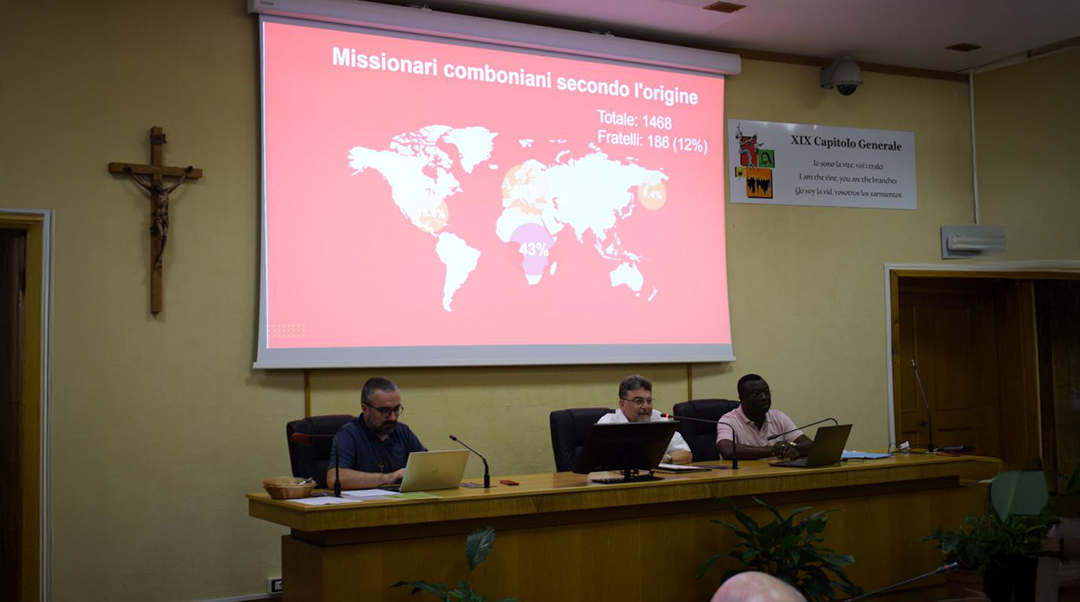
In view of the Jubilee of the Missionary World (October 4-5, 2025), Father Luigi Fernando Codianni, Superior General of the Comboni Missionaries, reflects on the significance of mission today. The Comboni Missionaries account for 1 470 members hailing from 48 countries. They are present in 41 countries across Africa, America, Asia, and Europe.
INEQUALITY IN AFRICA: WHAT DRIVES IT, HOW TO END IT, AND WHAT SOME COUNTRIES ARE GETTING RIGHT
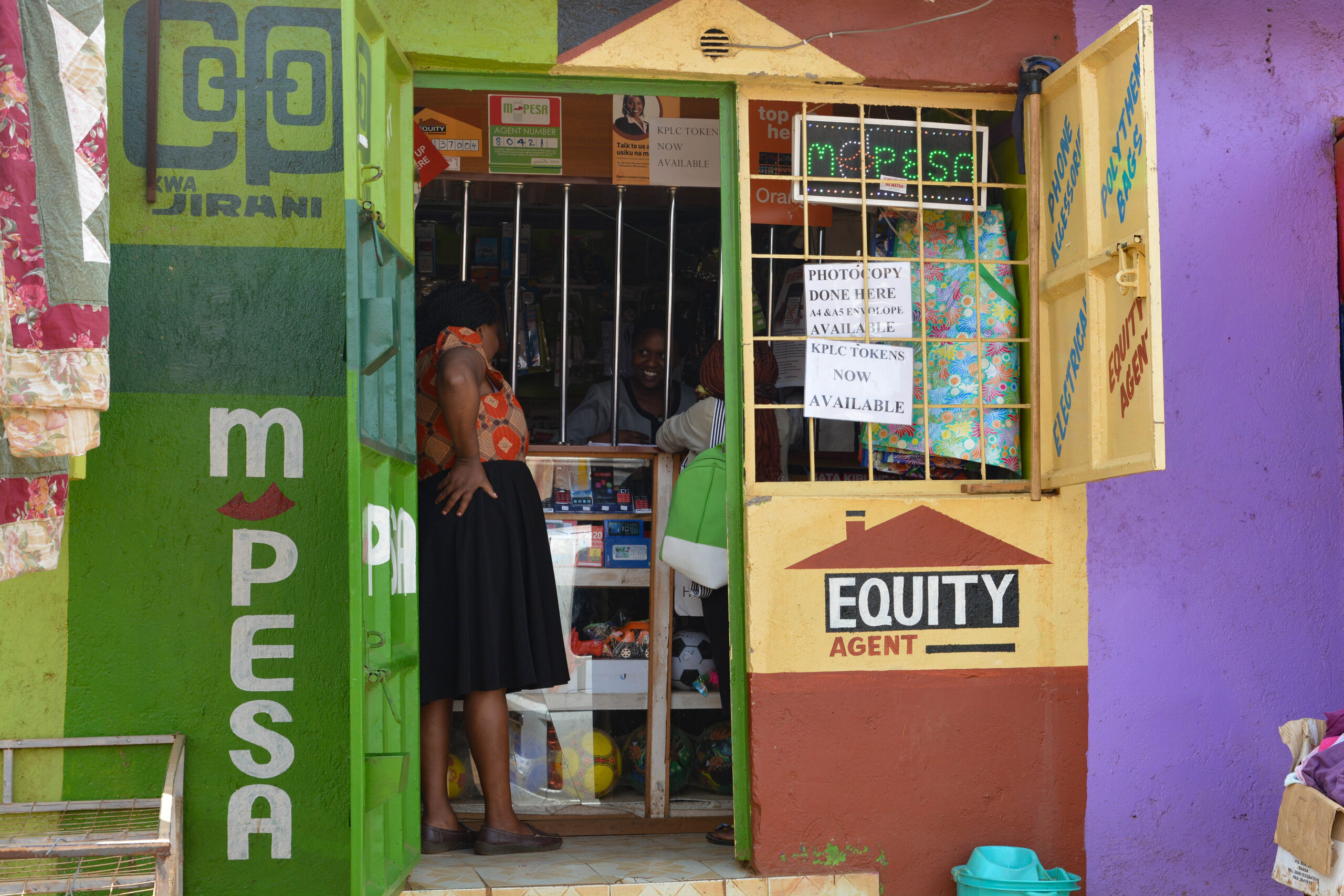
Inequality is the result of a host of factors, including policy choices, institutional legacies, and power structures that favour elites.