
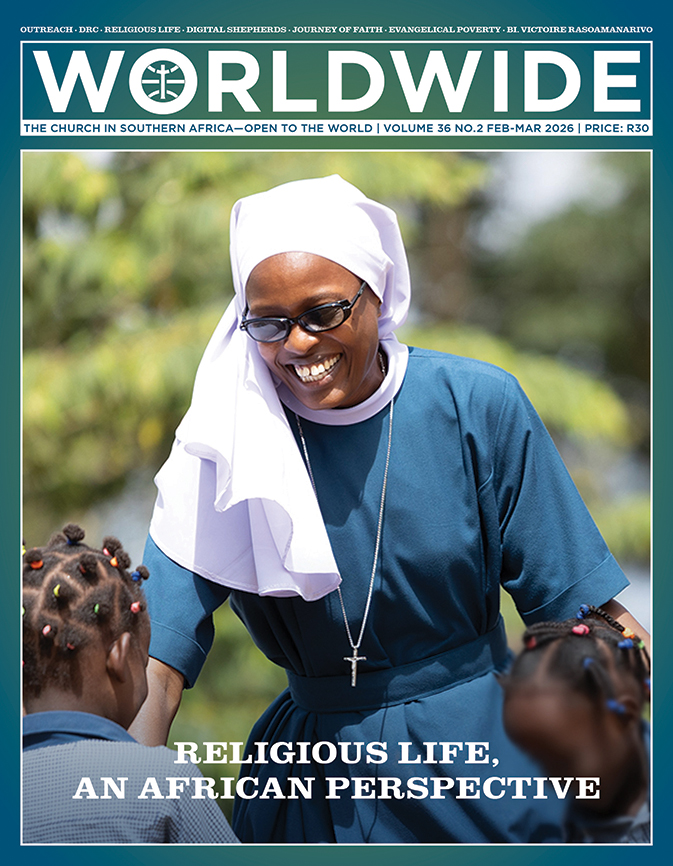
Religious Life, AN African Perspective
The Immaculate Heart Sisters of Africa (IHSA) is a Catholic religious congregation focused on education, evangelization, and empowering vulnerable women and girls, particularly against harmful practices like Female Genital Mutilation (FGM) and child marriages. The cover photo shows a member of the IHSA congregation playing joyfully with children in the Gerald Goldin Memorial Day Care and Nursery School, which they opened in 2022 in Kisarawe, Tanzania.
Reflection • EVANGELICAL POETRY
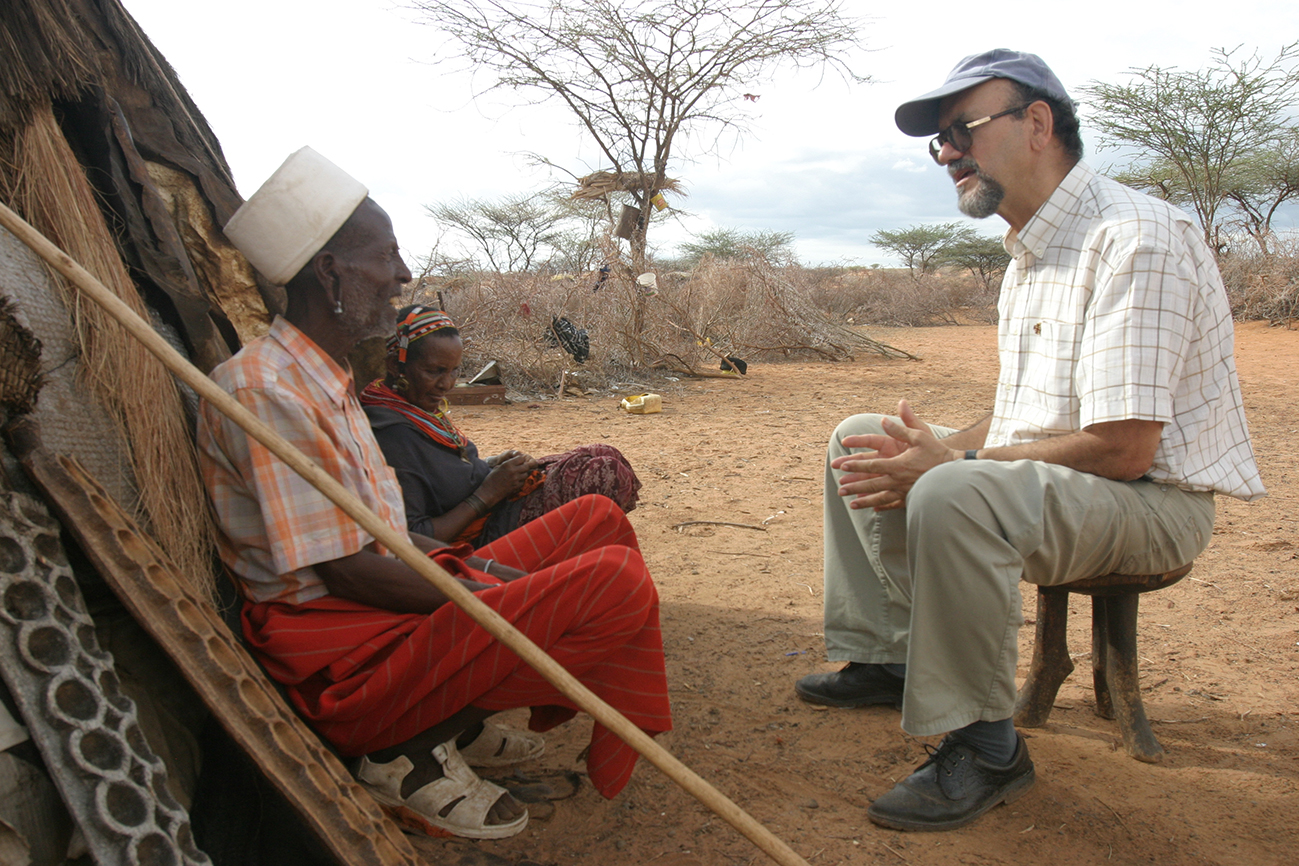
When God Dances
A young Dominican priest in Kenya shares his thoughts on the malaise of his nation. He does not hide his disgust for the many cases of corruption registered and denounced every day, and for the fact that nobody seems to be able to get to grips with this scandalous situation. Reflecting on his religious consecration, he dares to propose an astonishing remedy: the rediscovery of the profound anthropological significance of ‘evangelical poverty’, a poverty which nourishes that hunger and thirst for justice that God has promised to satisfy.
BY REV FR. LEO S. I. MWENDA, OP
IN THE Post-Synodal Apostolic Exhortation of John Paul II on the consecrated life and its mission in the Church and in the world, titled Vita Consecrata, published in March 1996, it is stated; “Poverty proclaims that God is man’s only real treasure” (21). Poverty is qualified as “evangelical”, since, together with chastity and obedience, they make up the so-called “evangelical counsels”, whose profession “is an integral part of the Church’s life and a much- needed incentive towards ever greater fidelity to the Gospel” (ib. 3).
This statement challenges Christians to reflect on the priority list of their values. It is true that the challenge is presented, first of all, to religious men and women, by virtue of their profession. Yet, it seems to me that it is also applicable, once the necessary changes have been made, to all Christians and, in our specific case, to all Kenyans at this crucial moment of their history.
The incentive to reflect on this theme arises in me because of the incredibly long litany of graft scandals we have been reading about in the recent past. As early as 2016, it was estimated that Kenya was losing a third of its budget to corruption. This is not surprising at all, if the proven and alleged financial scandals that have come to light so far are anything to go by.
Financial Scandals
In the first half of 2018, financial scandals involving hundreds of millions or even billions of Kenya shillings were unearthed at the National Cereals and Produce Board, Youth Development Fund, National Youth Service, Kenya Pipeline Company, and Ministry of Health, among others.
When you see corruption and bribery become so much part of a people’s culture – from the lowest to the highest echelons of society, both in the private and public sectors –, you cannot but wonder where and how we went wrong? Why would individuals seize common resources, so massively and pervasively, with little or no regard for the well-being and the future of the community?
I guess that, if we could ask the perpetrators of this injustice whether their intention is to bring to collapse the social, political and economic systems of the country, they would quickly answer: “Far be it from me that I should harbour such an evil intention!”. It is likely that they are honest in saying so, because, when they steal from the public coffers, their intention is not to cause the country’s total collapse. What occupies their minds is the determination to become rich (materially rich), allured as they are by the many advantages and privileges associated with being wealthy.
If a society is characterised by widespread thirst for material wealth, what is likely to ensue is a situation of competition for opportunities to amass riches. Such competition is not necessarily immoral in itself. Yet, if accumulation of goods is the first value of the majority of the members of a society, this competition is certain to rapidly turn tragic and become messy, dirty and bloody.
Moral considerations


Fr Chris goes on to note that even at the most basic molecular level, science describes matter as movement, as vibration, or rhythm, or even dance. For example, physicist and theorist Fritjof Capra noted that “Modern physics has thus revealed that every sub-atomic particle not only performs an energy dance but also is an energy dance; a pulsating process of creation and destruction” (Capra 1975:244). I find myself wondering whether, if every culture dances, this universal impulse moves in harmony with something resonant in the divine mind or with the spiritual rhythm imprinted throughout the cosmos.
The issue deserves deeper investigation. I repeat: though the motive driving the desire to become rich may be questioned, the intention of accumulating wealth is not necessarily inherently evil. It is the means used to achieve such accumulation that is flatly evil, since it is outright theft.
One does not need be a Christian and to know the 10 Commandments to equate theft with evil
Stealing is disregard of the law of God, summarised in the Decalogue, which coincides with natural law. One does not need to be a Christian and to know the 10 Commandments to equate theft with evil. Every human culture label stealing as evil, since the human mind, created by God, has the capacity to perceive the injustice inflicted on the victim of theft. In other words, stealing is against the dictates of natural law and is in opposition to right reason.
When people choose theft to amass riches, they undermine both their honest relationship with God and their humanness. Moreover, such option is tantamount to disregard of the wellbeing of other human beings, since it causes people to value material things more than interpersonal relations. For looters of public goods, love is not a value; and if indeed it is, it can not be situated very high on their value pyramid. Ultimately, they are incapable of love. They may become materially rich and enjoy all the advantages of their wealth, but their life is by definition “less-than-human”. By destroying interpersonal relationships with other people, they cause injury to the very fabric of society. If the majority of people were to harbour this motive, society would be doomed to collapse.
The Kenyan Youth and Corruption
A research study carried out in 2016 by Alex O. Awiti and Bruce Scot, of the Agha Khan University, claims that the majority of Kenya’s young people love their country and respect hard work, yet their “desire for entrepreneurship – starting and owning a business, as opposed to paid employment – is not compatible with what appears to be a high tolerance for corruption, tax evasion and a desire to make money by any means possible… Moreover, youth’s (lack of) concern about a future that will fall short on ethics and be plagued by corruption demands urgent and collective attention”.
“God is the true wealth of the human heart.”
It is against such a worrying analysis that I dare to call upon the treasures of the spirituality underlying the profession of evangelical poverty as an antidote to this mentality. If our youth are confused about honest and just social-economic ethics, it is because we, the adults, and the education system we have created, have failed them. They have been intoxicated by the tribal rhetoric and the nepotism that characterise our speech and actions. They have seen us showcase the wealthy as epitomes of human achievement, with no reference whatsoever to the quality of their ethical life. They have been deceived by the superficiality of our media, by the lying tongues of our politicians, and by the many false prophets that spread deceitful messages.
Poverty as prophetic challenge
The theology of evangelical poverty offers us radically new thinking and a new approach in addressing the root causes of our misery. The spirit of evangelical poverty calls into question today’s “materialism which craves possessions, heedless of the needs and sufferings of the weakest, and lacking any concern for the balance of natural resources” (Vita Consecrata, 89). Against the disordered desire to accumulate wealth as the surest way to distinguish ourselves from the mass of those who languish in utter misery, evangelical poverty “attests that God is the true wealth of the human heart… and challenges the idolatry of money, making a prophetic appeal, as it were, to society, which risks losing the sense of proportion and the very meaning of things” (ib. 90).
Today more than in other ages, “the call of evangelical poverty is being felt also among those who are aware of the scarcity of the planet’s resources and who invoke respect for and the conservation of creation by reducing consumption, by living more simply and by placing a necessary brake on their own desires” (ib.). This witness, of course, “will be accompanied by a preferential love for the poor and will be shown especially by sharing the conditions of life of the most neglected” (ib.).
One may wonder whether I am making a call to “sacralise” material poverty. By no means! Far from sacralising material poverty, the spirit of evangelical poverty creates a state of spiritual and bodily tranquillity that allows society as a whole to create sufficient wealth for her members, and shifts the basis of people’s hope from materialism to graced humanism, as proposed by Christian faith.

A Call for Moral Consciousness
It is high time Kenyans re-examined their hierarchy of values, so that they gain the courage to admire and emulate the virtuous man or woman, and not the corrupted rich. Let us reform our channels of public education (schools, media, religious institutions and law-making processes) and shape them in such a way that they give virtuous living greater prominence than materialistic living. This will have concrete positive consequences for our society. In love with evangelical poverty, we will fight to overcome hunger and its causes; we will inspire the activities of voluntary associations and humanitarian organisations; and we will work with public and private bodies to promote a fair distribution of international aid. Let us be honest and recognise that nations truly owe a great deal to those inspired by evangelical poverty, whose tireless generosity has contributed and continues to contribute greatly to making the world more human.
Saving ‘economy’
You do not have to be a genius to realize that material goods can never guarantee true happiness. Happiness is by nature spiritual, and no amount of material benefits can translate into a spiritual commodity. When material objects are mistakenly thought to be the source of happiness, the rush to gather them inevitably translates into greed, a vice that causes the strong trampling on the weak, who are always the majority. This will inevitably become a source of discomfort for the wealthy minority. The net result is the exact opposite of the expected goal: all-encompassing unhappiness and unease.
Happiness is by nature spiritual, and no amount of material benefits can translate into a spiritual commodity.
Christians may appreciate earthly goods, since they receive out of God’s hands, but they consider themselves their stewards, not their owners. They deal with them as “economic goods”, but in an “economy of man’s salvation”.
Christian hope recognises that the bodily well-being sought by ‘secular hope’ is a necessary, but not sufficient factor in the integral realisation of the human person’s destiny. That is why it seeks to redeem it from its shortsightedness and unstable foundation, by escalating it to the broader scheme of God’s salvation plan. In this way, earthly goods become useful complements in the Christian ‘economy’ of salvation and hope.

When God Dances
In every culture and faith, music and movement arise as languages of the soul and expressions of a deeply relational humanity. To dance is to join, even faintly, in the rhythm that undergirds sacred living and creation’s calls toward justice.