
WORK AND HUMAN DIGNITY
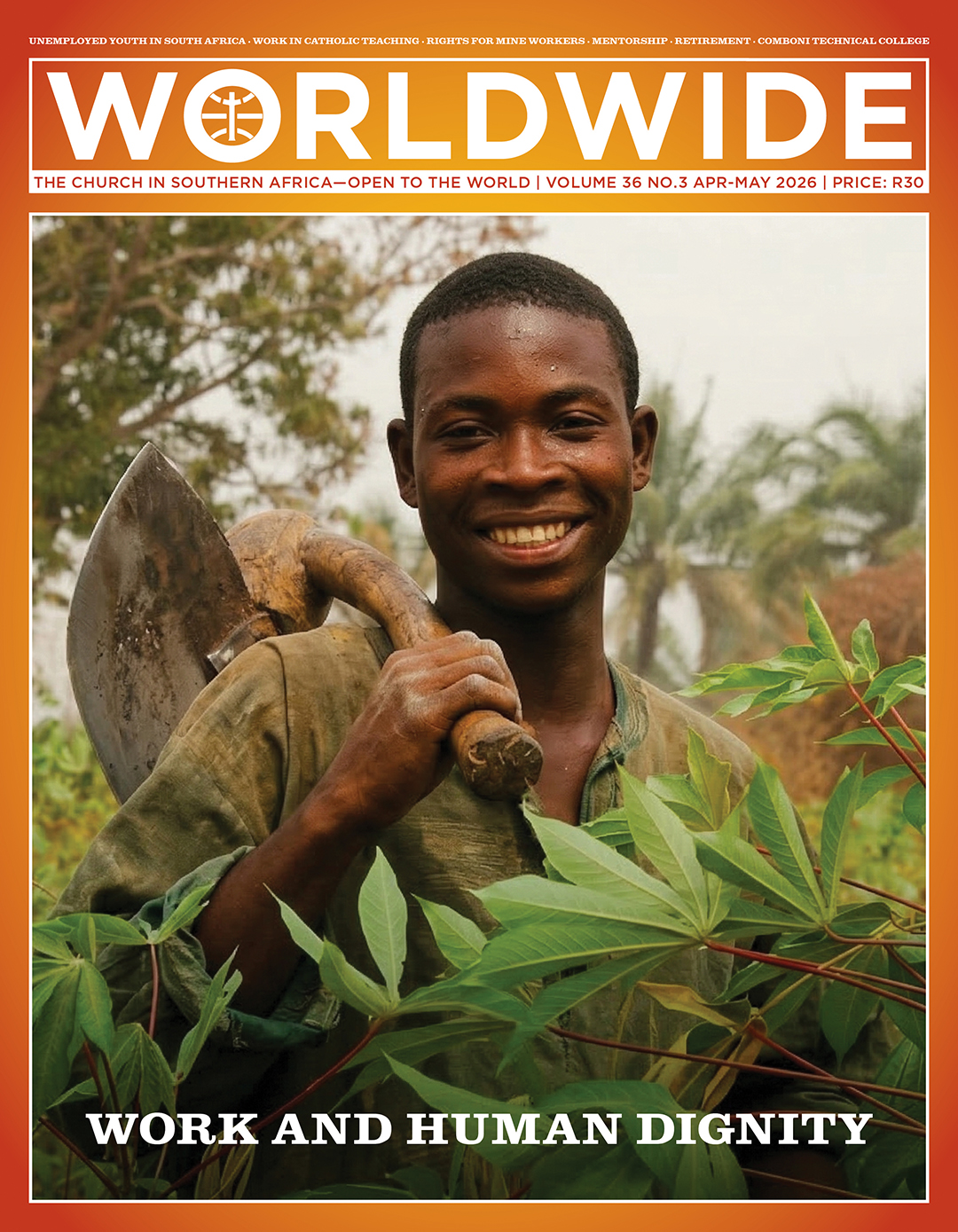
A young farmer holding a hoe in a field of cassava plants. In Africa, cassava is the second most important staple food after maize, providing the primary energy source for approximately 40% of the population. Due to high levels of unemployment, small- scale farming provides a dignified way of self-sustenance.
SPECIAL REPORT • SMALL FARMERS
A Bitter Chocolate
Religious communities can demonstrate that cultural and racial differences must be viewed from a positive perspective and be promoters of justice, peace and integrity of creation.
BY Michele Bollino
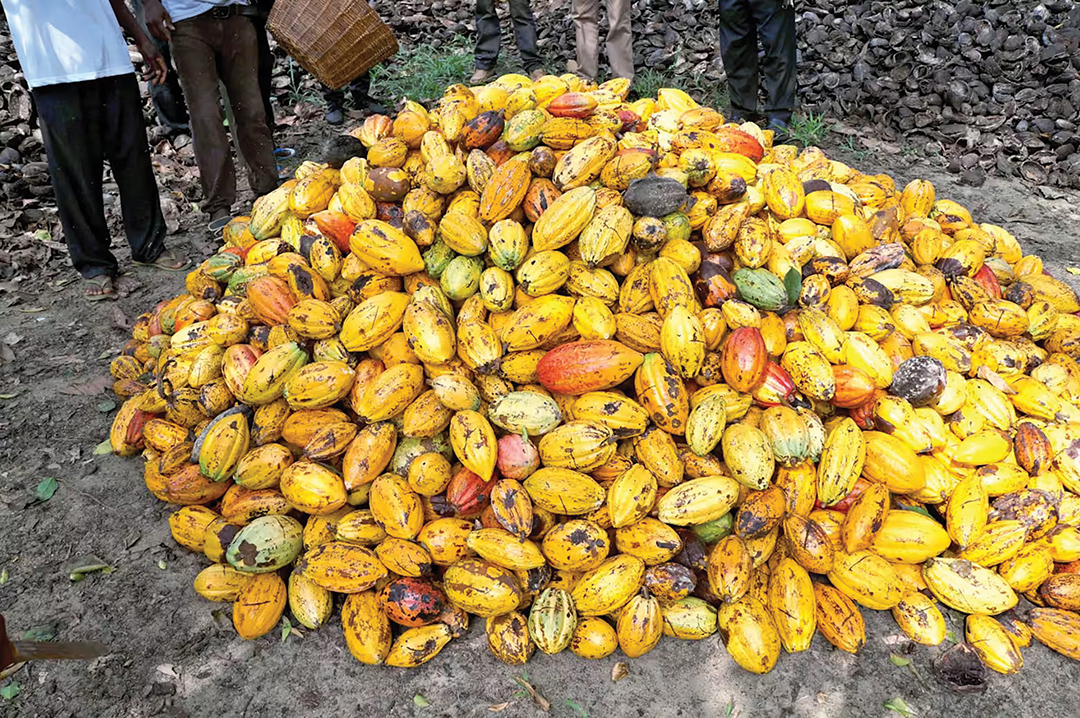
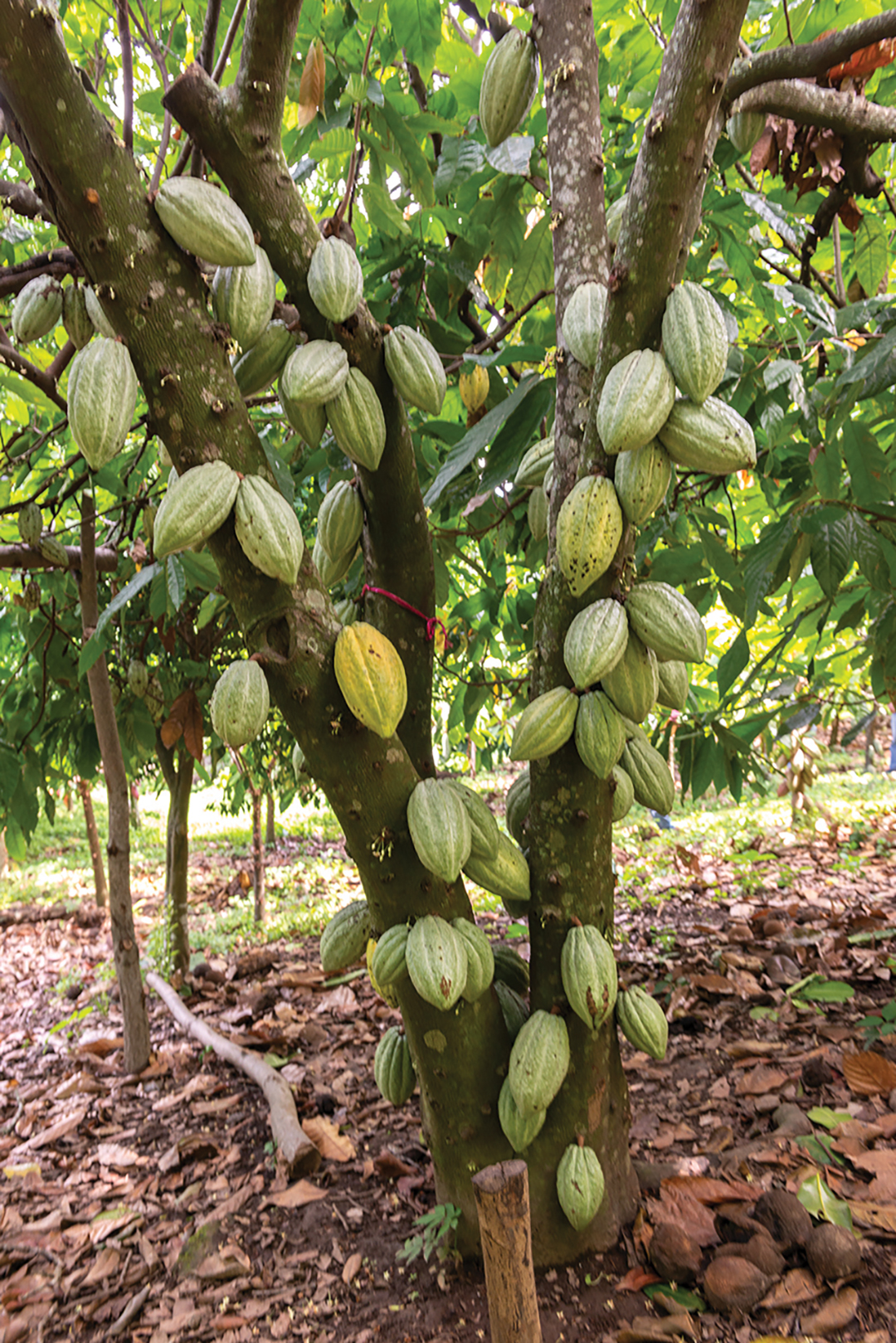
UNDER THE shade of trees, Seydou spreads a plastic mat on the mud. Around him, white piles of cocoa beans ferment while the air is filled with a sour odour. “Now, I live and sleep here,” he declares, exhausted. “I can’t afford to go home. If I leave, the thieves will take everything. And this harvest is all I have.”
The city of Gagnoa, capital of the Gôh-Djiboua region in southwest Ivory Coast, is one of the most important cocoa producing centres in the country. Over 75% of the area’s inhabitants are involved in this activity, which alone accounts for 15% of Ivorian GDP.
This figure reflects the importance of a sector capable of satisfying over 40% of global demand, making Ivory Coast the world’s leading cocoa producer.
“But it’s a job that’s becoming increasingly difficult,” Seydou explains. “Climate change is transforming everything, and government policies are making our lives impossible. Here, we are all small farmers united in cooperatives; the government knows it and controls us. We are not even free to sell to whoever we want,” Seydou continues, “we are forced to sell to the state at a miserable price. That is why, those who can, grow without following the rules. And thefts are now constant.”
Too much rain or too much heat
Seydou emphasizes that the root of the transformation in cocoa farming is climate change. The rainy seasons have seen a sharp increase in rainfall, while heat sets new record levels annually during the dry seasons, with a 20% increase in droughts in recent decades.
For cocoa farmers, this means more plants become diseased from excess water during the rainy season, and bear fewer fruits during the dry season.
“With this 10-hectare plantation,” Seydou says, “until a few years ago, I was able to produce over five tons of cocoa beans. But in recent years, I have not once managed to exceed three tons.”
The worst year Ivorian farmers can remember was 2023/24. As certified by the International Cocoa Organization (ICCO), extreme weather events in Ivory Coast caused a drop in production of about 15%.
Global markets responded immediately, recording a surge in the price of the raw material. This wealth, however, has not reached the hands of farmers.
State-imposed limits
In Ivory Coast, the price of cocoa is not left to the market but is set by the Conseil du Café-Cacao (CCC), a state body that acts as the public regulator of the entire supply chain.
In September, before the start of the main season, the CCC sells about 80% of the expected harvest on international markets, thus setting an advance price that becomes the basis for the domestic price.
The goal is to guarantee producers a stable minimum price, shielding them from price volatility.
“We are witnessing a decline in production that cannot be explained by climate change alone…”
“But in 2024,” Seydou explains, “the price set by the government was CFA Francs 1 000, equal to about €1.5, per kilo. In neighbouring countries like Guinea and Liberia, however, the price was over CFA Francs 6 000. This triggered a real rush to smuggle, and the theft of cocoa beans exploded. And the situation hasn’t improved today. The government has raised the price for producers to CFA Francs 2 400 per kilo, but it’s still less than half of what is paid outside the country,” the grower adds.
In this situation, those who can are leaving the controlled market.
“In all the regions bordering Guinea and Liberia,” explains A.K., an official at the Central Syndicale Agricole de Côte d’Ivoire (CSACI), an organization that brings together the country’s main farmer unions, “we are witnessing a decline in production that cannot be explained by climate change alone. Many producers are reporting an increase in theft, but many have simply stopped declaring their production and sell the product directly abroad.”
According to the producers’ union, which, together with the government, has launched an awareness campaign in the border regions, “this phenomenon is causing many problems. The first,” A.K. continues, “is a huge loss of money for the state coffers. According to the Ministry of Agriculture, in the last three years we have lost cocoa worth of about $1.5 billion. Then there is the issue of international credibility.”
To comply with European regulations against deforestation, we are developing the ARS-1000 certification, a system established by the African Regional Organisation for Standardisation to ensure sustainable cocoa production, to establish a controlled supply chain.
“But the exit of many producers from the system is damaging all the work done and risks compromising trade with Europe, which is the world’s leading market for cocoa consumption.”
Smuggling or subsistence?
Of particular concern, however, is the internal situation. The wounds of the civil war have not yet completely healed, and Ivory Coast, a country with more than 60 different ethnic groups, still presents a political framework that is uncertain.
“Rivalry between the different regions is extremely high,” explains A.K., “and those who live in the centre or in the east of the country are unable to sell their products abroad, because our prices are coordinated with Ghana. Accusations of unfair competition against residents of the western regions are therefore multiplying, and although the government has deployed the police to combat smuggling, it is not uncommon to hear commentators, on TV or radio, calling for more repressive measures against these regions.”
Those who live in the border areas, however, do not accept this narrative and reject the accusations.
Kouadio lives in a village a few hundred meters from the Cavally River, which marks the natural border between Ivory Coast and Liberia. It took him a whole day to travel the 250 km that separate him from Gagnoa.
“And every day, it takes me more than an hour to transport the cocoa from my field to the collection centre. More than an hour to travel less than 20 km.”
According to residents of the western regions, the problem is simple.
“In this part of the country,” says Kouadio, “there are no roads. In recent years, Ivory Coast has developed so much and roads have reached almost everywhere. But not here. And without roads, there are no buyers. Our choice is not between selling to the state or to smugglers, but between exporting to Liberia or throwing away the entire harvest.”
Kouadio, however, is convinced that this problem stems from “a specific political choice. Gagnoa is the most important area for cocoa cultivation, but it also has the least infrastructure. This is because it is the stronghold of former President Laurent Gbagbo, rival of current President Alassane Ouattara. It is a way to keep us isolated from the rest of the country and to continue fomenting tensions.”
Kouadio also has a different view of the thefts.
“There is no ‘cocoa mafia,’ as the TV channels now call it. The Cavally River is small, easily crossed with small pirogues. The smugglers make deals with Ivorian fishermen who, in a couple of days, can earn a month’s wages. This isn’t organized smuggling, but subsistence.”
The data, however, shows a different scenario. From October 2024 to March 2025, the Ivorian government seized over 265 trucks headed to Guinea or Liberia, for a total of nearly 600 tons of cocoa.
Cocoa smuggling is rapidly evolving into a structured phenomenon.
According to the authorities, these numbers have increased significantly compared to previous years, and reflect the increase in reported thefts across the country.
This is a clear indication of how cocoa smuggling is rapidly evolving into a structured phenomenon, capable of moving ever-increasing volumes through more and more organized networks.
Source: Nigrizia

DRC – A PROPHETIC VOICE THE SHEPHERD MUST STAY WITH HIS PEOPLE
The abundance of natural resources and Rwanda’s expansionist ambitions are the main causes of the wars that have been plaguing a vast area in the east of the DRC, as attested by the Bishop of Uvira.