
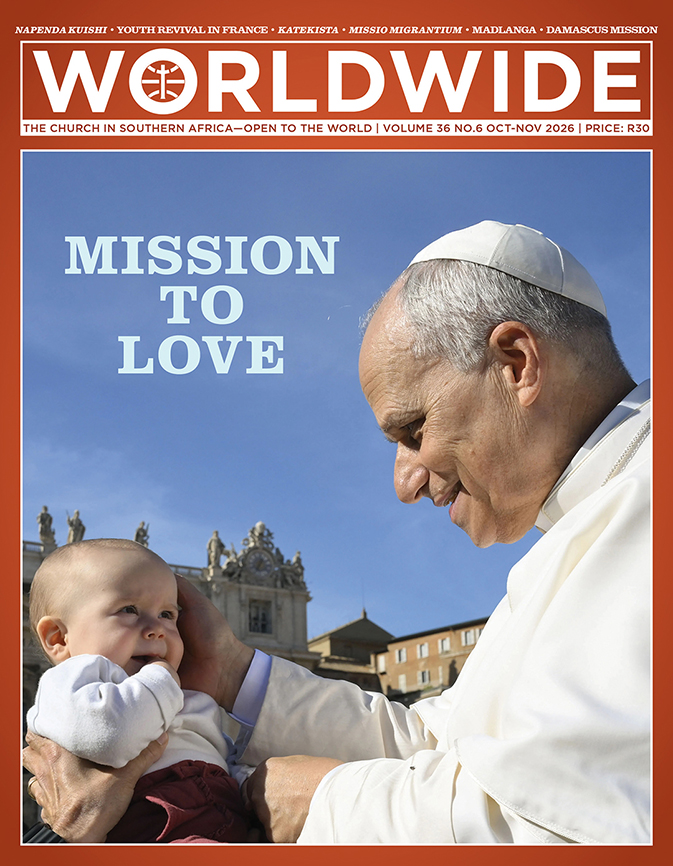
MISSION TO LOVE
Pope Leo XIV smiles while blessing a baby in St Peter’s Square—a gesture reflecting his closeness to the “little ones.” In his message for the centenary of World Mission Day in 2026, the Pontiff emphasizes: “The mission of the disciples and the Church as a whole is to continue the mission of Christ in the Holy Spirit: a mission born of love, lived in love, and leading to love” (§ 3).
Photo Credit: Francesca Pollio Fenton/aciafrica.org
Profile • FR JOHN LYDON OSA
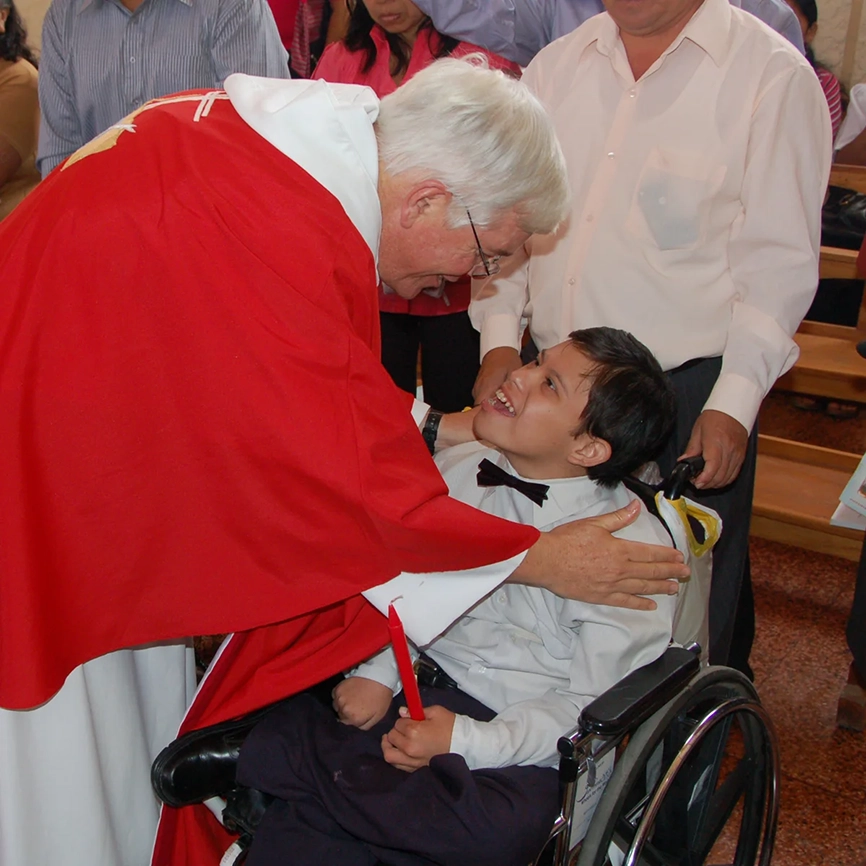
A BROTHERHOOD BUILT ON FAITH, LOVE, AND SERVICE
No sooner had the white smoke gone up and Robert Francis Prevost declared Pope Leo XIV than journalists began delving into his past. What was his history? Who knew him?
BY Marian Pallister | Chair of Pax Christi Scotland
ONE MAN became the target of their grilling, sometimes resulting in facile reports that made Fr John Lydon seem like some sort of Leo groupie, a sycophant hanging onto the new pontiff’s soutane, picking pathetically for attention at the 33 buttons on that papal garment which signify Christ’s life on earth. Yes, Fr John Lydon has known the man who is now Pope Leo for more than four decades. But rather than being some ‘hanger-on’, Lydon has a pedigree that outclasses most clerics. We haven’t known about that pedigree because this gentle, quietly spoken man, with his shock of white hair, has a modesty that matches Pope Leo’s own. His years as a missionary, an educator, a theology professor, an author, and so very much more are facets of his life that we must hear from others, not from him.
Academic background
Knowing ‘Fr Bob Prevost’ isn’t his defining factor. Exploring the life of Fr John Lydon OSA is a deeply rewarding exercise. He’s a Canadian, born in Toronto in 1955, and began his journey toward becoming a missionary, educator, theology professor, and more at Villanova University in Pennsylvania. This private Catholic research university is one of two Augustinian institutions in the United States. Founded in 1842 and named after St Thomas of Villanova, the university certainly influenced Lydon’s life choices. He (and Robert Prevost) graduated in 1977, and just a few months later he entered the Augustinian Order. He completed his theology studies at the start of 1983 and immediately volunteered for missionary work in South America.
At the age of just 28, he travelled to Chulucanas, a city in the northwest of Peru close to the foothills of the Andes. There he spent five years in the Augustinian parish of San José Obrero (St Joseph the Worker) before being sent to the Gregorian University in Rome to complete his doctoral studies in Mission Theology.
Happy to be an Augustinian
Then it was back to Peru, where he joined the formation team in Trujillo along with Fr Bob Prevost, also an Augustinian. The two worked together in that community for a decade. Lydon served in several parishes, as well as acting as the Augustinian mission’s Superior three times, and working as a theology professor at the Catholic University of Trujillo. He later became President of the university.
As if this heavy and varied workload wasn’t enough, he was elected twice as the head of the Organisation of Augustinians of Latin America, coordinating activities between the many Augustinian communities spread across twelve Latin American countries.
Although the spotlight has now fallen on his relationship with Fr Bob Prevost, Fr Lydon has said: “…at every low point, high point and every day in between, I have been blessed to have wonderful Augustinians by my side! So many have made a difference in my life; I cannot begin to name them all!”
And yet, he has noted that while most lay people know at least something about the Jesuits, the Franciscans, Benedictines, and Carmelites, “they don’t seem to know who the Augustinians are, and what gifts they uniquely bring to the life of the Church.”
Encounter with Augustinians
He got to know about the Augustinians when he was a student at Villanova University. He was taught by several professors who were Augustinians and who clearly influenced his decision to join the order.
During his decades in Peru, he visited most of the countries in South America and Central America where Augustinian communities were to be found, and when he studied in Rome, he took the opportunity to visit Augustinians in Europe, and visited Hippo (in modern Algeria), where St Augustine became bishop in 395 AD.
According to Fr Lydon, all Augustinian communities act in the service of the people. He found there were a variety of styles of delivering mission, but all the communities are united in mind and heart/ or share one mind, one heart.
In Peru, “that was directed to the poor, the marginalised”, he says. For himself, he notes, it has been “a life of service; a rewarding life…a very fulfilling life”. Being an Augustinian has brought him into touch with people’s greatest sorrows and greatest joys, and he believes he has found “the face of God” in the poor. “Seeing in them the face of Jesus was the blessing of all my years in Peru.”
It was there amidst the poor and marginalised that the charism of Augustine seemed truly achievable. Lydon has explained it in a way that might well horrify the likes of President Donald Trump, but sounds very attractive to those of us who seek peace and a nonviolent world – like Pope Leo.
The Augustinian Influence
He explained in an interview how his friend and fellow Augustinian might approach his papacy: “Augustine talks in his Rule of Life about sharing resources, with everything in common; he talks about the need for forgiveness with those who offend us; he talks about sharing prayer, meals, and life so that no one suffers want because all share as brothers and/or sisters.”
And he added that this train of thought can only lead to concern for the poor. Listening to Lydon’s explanation recalls the Liberation Theology that was born in Latin America in the 20th century, and which was frowned upon by St Pope John Paul II – perhaps because it reminded him of communism’s basic tenets that spiralled out of control in the Soviet society in which he grew up. But Augustine’s concern, the concern of today’s Augustinians, of Lydon, who saw the face of Jesus in the poorest of Peru, is this care for, this inclusion of, the poorest members of society.
The Augustinian Missions, Lydon stresses, aim to identify all resources as being created for the good of all, not just a few; and that those resources should be used for the promotion of human dignity “as a fundamental concept based on the belief that each person is made in the image and likeness of God”.
Lydon’s Book
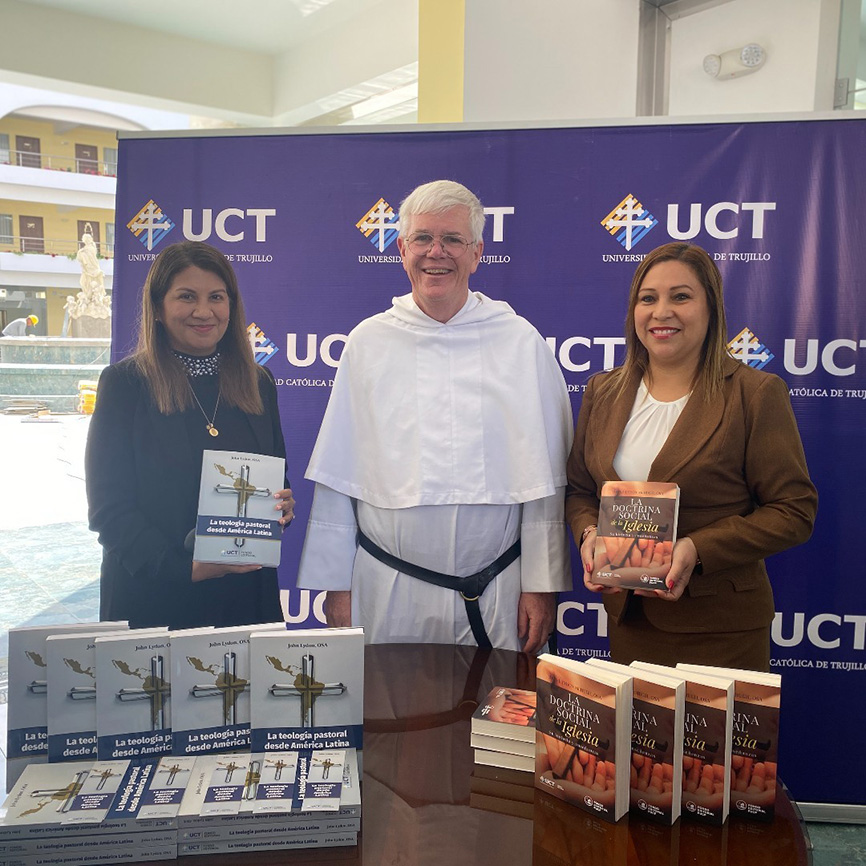
The above concept is straight from Catholic Social Teaching, which of course is the subject of Lydon’s recently published work, with a foreword written by, yes, Cardinal Robert Francis Prevost. Catholic Social Doctrine, Its History and Teachings was published (first in Spanish) in 2024 and provided an ideal excuse for Lydon to return to Peru. Most authors would be content to attend some book signings, and perhaps visit old friends, and Lydon did both. But he also taught a weeklong class at the international novitiate in Lima, then travelled to his old stomping ground of Trujillo, where he held similar presentations at the Catholic University, where he had served as president before returning to the United States.
He formally presented his earlier book on Latin American Pastoral Theology, published by the University Press of the Catholic University of Trujillo. Another engagement organised by the Chamber of Commerce of Trujillo highlighted themes from Catholic Social Teaching.
Enough for a man approaching 70? This was Fr John Lydon, and of course he made time to visit a charity set up recently to promote human integral development, and to engage with local communities – education and social justice being his priorities wherever he goes.
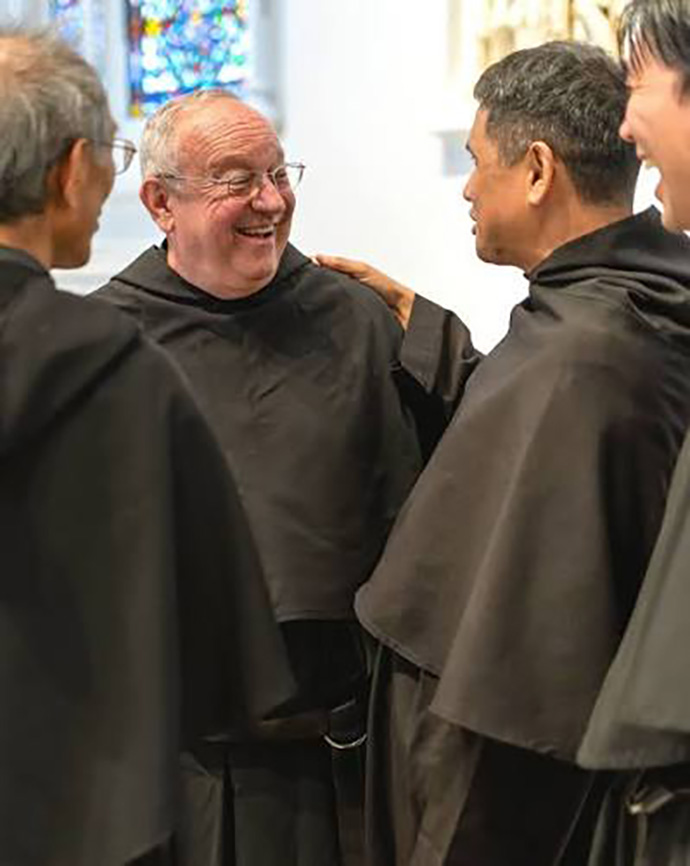
Credit: augustinians.stov/Instagram.com
From Peru to the Mother Cabrini Institute
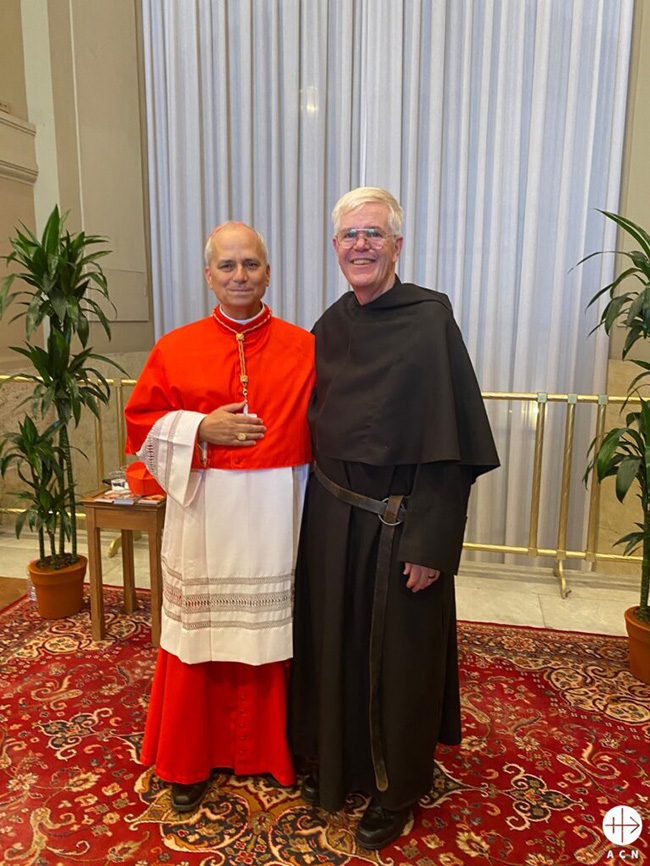
Regarding most aspects of his life, Fr John Lydon does not follow the obvious route. One would have imagined that after 40 years in Peru, there might have been thoughts of retirement. Instead, he joined Villanova University in August 2023 at the Office of Mission and Ministry. He became director of the Mother Cabrini Institute on Immigration at the university, an enterprise that brings together university and community partners, offering teaching, scholarship, training, and service opportunities in the local community with migrants and refugees. Of course, Lydon’s and Villanova’s core Augustinian values of Veritas, Unitas and Caritas are consistent with the principles of Catholic Social Teaching. In October 2025, Lydon visited Rome for a conference organised in 2023 by Villanova University. The theme was migrants, and he had been on the steering committee. Hence, he had to attend, even though he had moved on from Villanova – and of course he was able to meet with his old roommate Bob from Trujillo days.
Looking to the Future
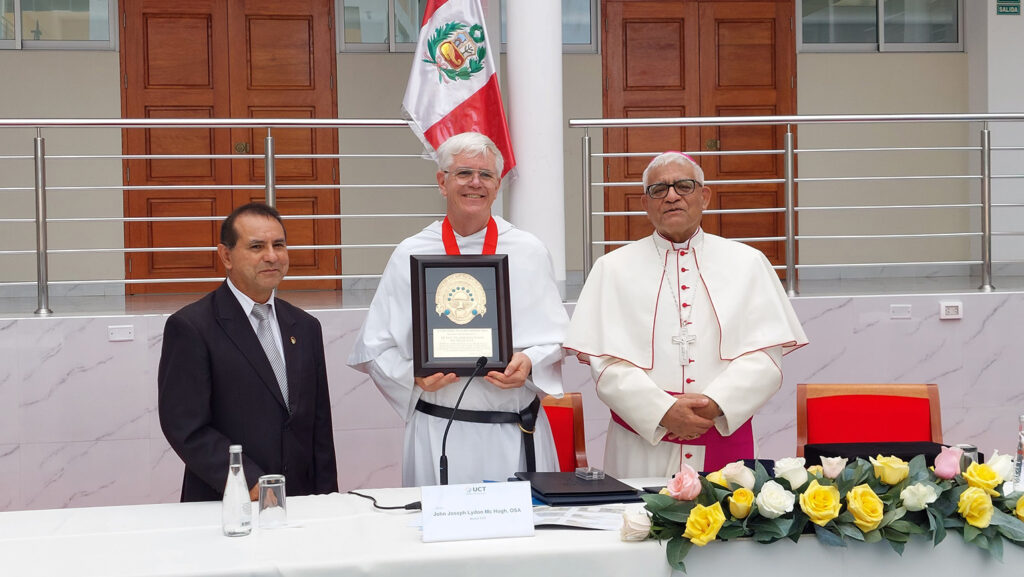
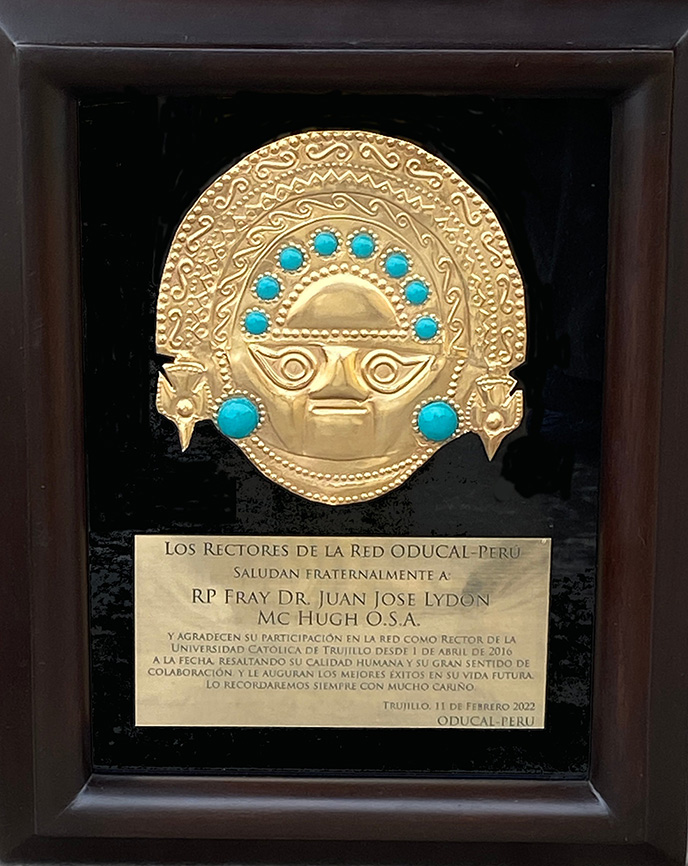
When he received a medal as he was coming to the end of his time in Peru (this was in February 2022 when the Archdiocese and the Catholic University of Trujillo organised an event to mark his six years as president of the university), Archbishop, Miguel Cabrejos spoke of Lydon’s pastoral zeal and great responsibility; of the “important responsibilities” he had undertaken from the age of 28 until his (then) late 60s, such as formation director and superior in his Religious Community; as parish priest, Episcopal Vicar and Vicar General; as professor at the Major Seminary “San Carlos and San Marcelo” as well as of Trujillo University; and from 2016 holding the position of Rector of the university. Much was said about the way he had improved every aspect of the university, including links with other Catholic universities around the world.
But the Archbishop stressed “…the high level of his service could not be understood in its proper dimension if we do not take into account his high human quality and his fidelity to his priestly and religious life”.
“Seeing in them the face of Jesus was the blessing of all my years in Peru.” Fr Lydon
And he added, “I am sure that we will always count on his wisdom, with his special human and academic training, with his strength and his permanent service for the good of the youth and of our beloved Peru, through our university.”
After the spell at Villanova, from January 2026, Lydon has been living in Chicago in St Augustine’s Friary, a formation house to which young men from the United States and Canada come for their theology training and Augustinian formation. It’s a place very familiar to Pope Leo, who was formation director for a year after finishing his service as Prior General of the Augustinians.
But Fr John Lydon’s heart may forever remain in Peru with the poor and the marginalised, with the mission work which has brought him such great blessings.
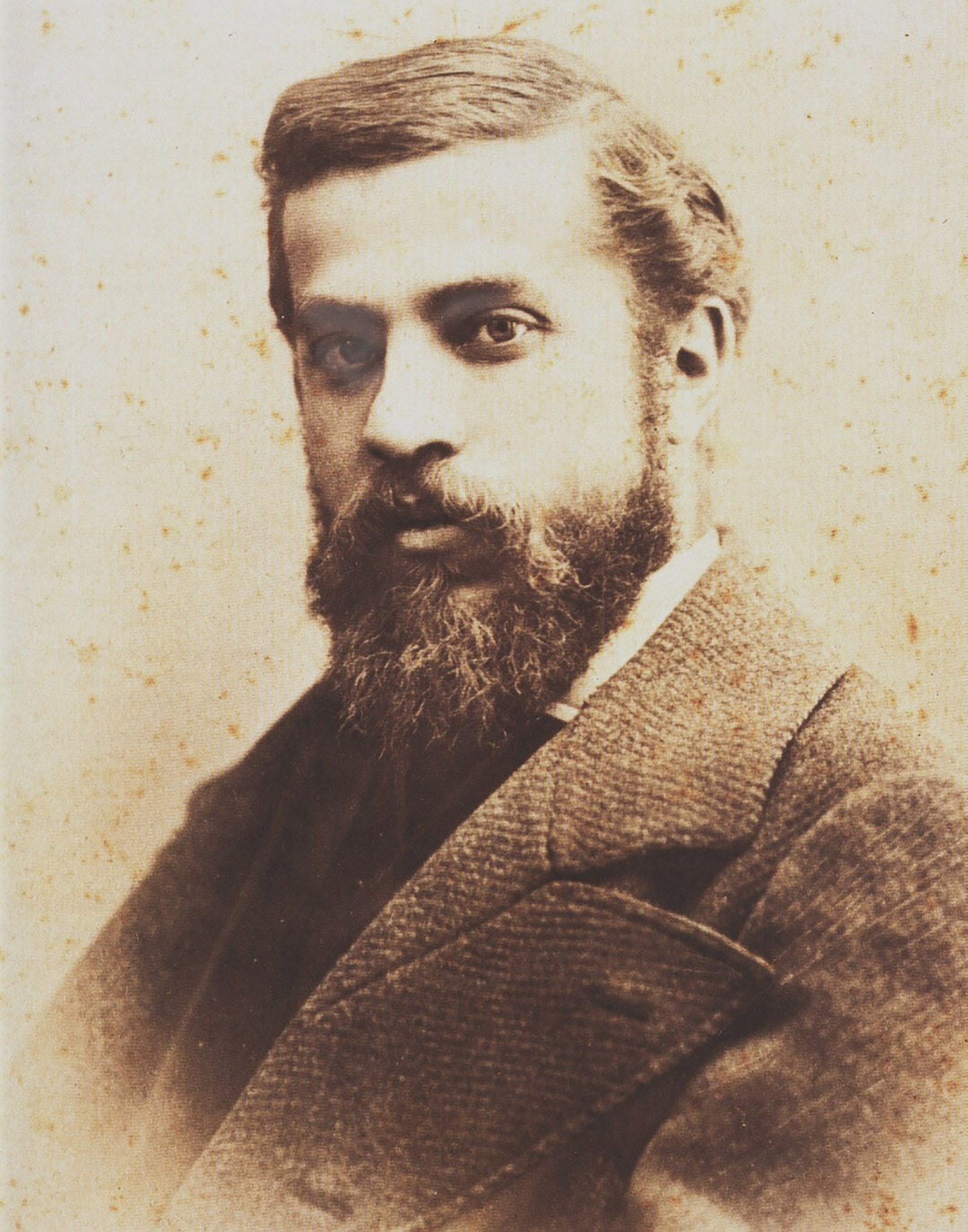
The “Architect of God”
A man of deep faith and an extraordinary craftsman, Antoni Gaudí dedicated his whole life to the creation of the Basilica of the Sagrada Família: a seminal work of art that reflects the Catholic doctrine in every space, every symbol. In 2025, the Church declared him “Venerable”.