

LIVING WATER
Every act of care for creation becomes part of a global stream of hope.
The cover page is inspired by the 2026 Season of Creation theme. In this season, our hope is that “Christians would be immersed in the living water flowing from the throne of God, stepping in deeper and deeper, inspired by the Spirit of God, working together for the renewal of Creation”
(Cf seasonofcreation.org).
Special Report • Ai’s High Stakes
Credit: beaconnj.org
Humanity Always Magnificent?
Who is really behind Artificial Intelligence?
BY Fr Joseph Caramazza MCCJ
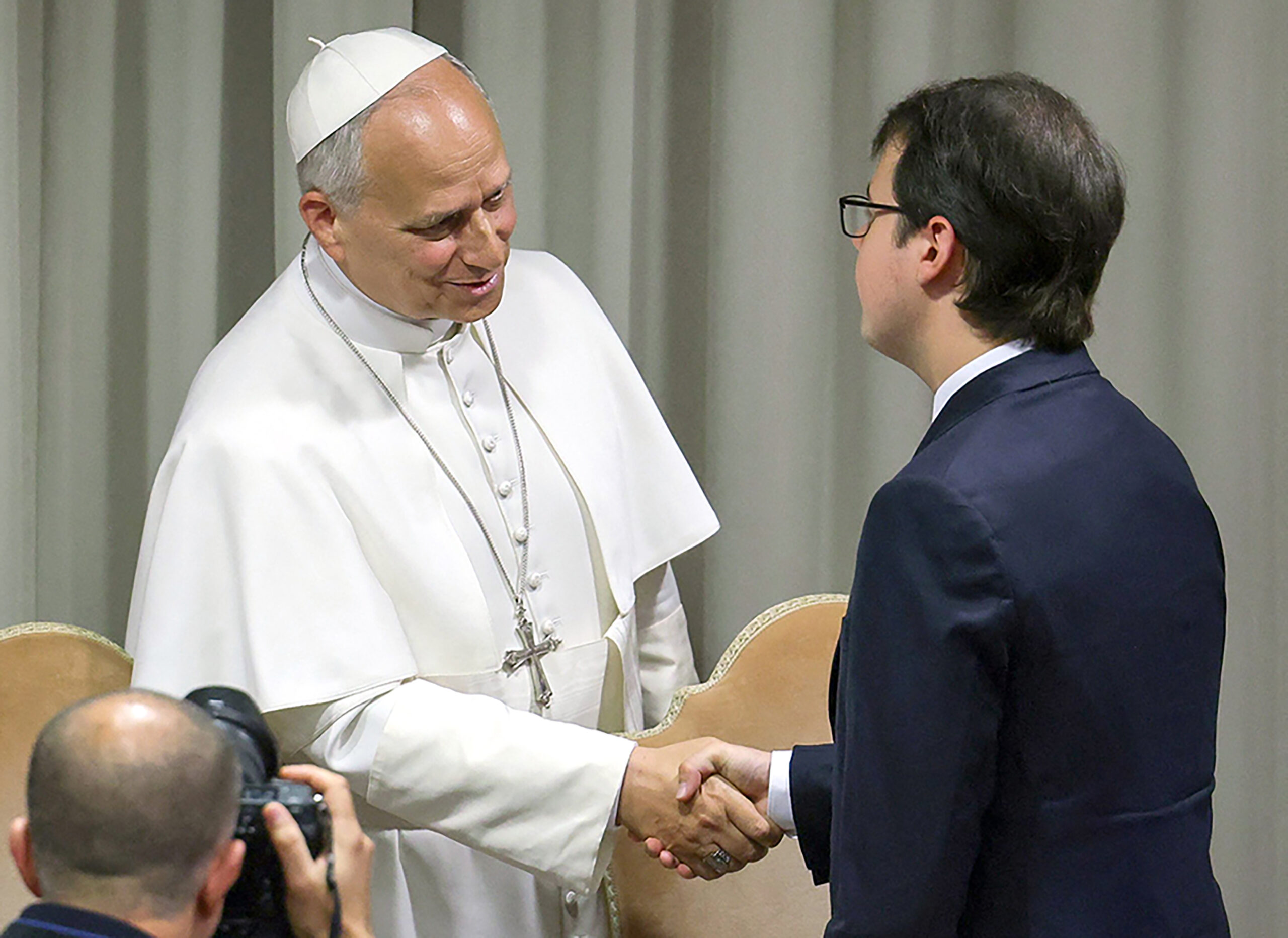
ON MAY 25, Pope Leo presented his first encyclical—Magnifica Humanitas—in the New Synod Hall in the Vatican. At the beginning of his address, the Pope said, “I heartily thank those who organized today’s meeting, and in particular those who shared their expertise and experience in the various presentations we have heard. I would especially like to thank Mr. Olah for accepting our invitation. In turn, on behalf of the Church, I accept his invitation to walk together, to listen and speak together to find the path for humanity in this age of artificial intelligence.”
Many were surprised by Christopher Olah’s presence alongside the Pope. Olah is a Canadian researcher and expert in neural networks—those that enable computer machine learning—and is one of the founders of Anthropic, a leading company in the field. Olah has often declared his atheism, so what was he doing alongside the Pope during the presentation of an encyclical? Olah was invited because he has never made a secret of his interest in developing artificial intelligence (AI) systems that benefit, but do not control society. This line of thinking is shared by Anthropic, which has refused to offer its services to military programs aimed at population control. During the meeting at the Vatican, Olah emphasized the danger of AI being used for massive social interventions that would drastically reduce people’s jobs and deepen the gap between rich and poor worldwide. Olah argues that many AI developers are not concerned with the public good, and he stresses the importance of religious institutions, scholars, and civil society acting as ethical overseers of the development of these technologies.

Olah’s beliefs are in stark contrast to those of Peter Thiel. Thiel is an entrepreneur who has invested heavily in the development of AI. He defines himself as a libertarian and bases his beliefs on the work of Ayn Rand, philosopher and founder of the Objectivist movement, which theorizes the total sovereign individual. According to this movement, the individual is important, his or her freedom is fundamental, and everything collective, everything social, is evil because it sacrifices the individual for its own ends. Ayn Rand declared herself an atheist and was opposed to all organized religions. One of her last essays—Requiem for Man—was a fundamental and radical critique of Populorum Progressio, one of the Catholic Church’s most important social encyclicals.
Torn by these conflicting ideas, Thiel believes that only AI can save humanity and enable a technological leap that will benefit the world. This is why he invested significant capital to found Palantir. Palantir uses AI to develop surveillance systems used by the military, as well as the infamous ICE (the US Immigration and Customs Enforcement Agency). This shouldn’t be surprising, given that Thiel is a Trump supporter, a seeming contradiction for someone who claims to be a libertarian.
AI Architects
Thiel is not the only AI architect. All major technology groups are committed to developing AI-based systems. US Big Tech companies have the capital, computing infrastructure, and data needed to innovate in this sector. Bill Gates, the founder of Microsoft, has become the main partner of OpenAI, whose co-founders include Elon Musk. Elon Musk is also active in the market with Grok, a series of neural networks he uses in his industrial and aerospace projects. Google founders Larry Page and Sergey Brin founded DeepMind, which produces Gemini and other AI-driven products. Jeff Bezos, of Amazon, has his own AI company (Q) and controls the largest cloud infrastructure. Mark Zuckerberg, founder of Facebook and Meta, controls AI programs like Llama, which he offers free of charge for both commercial and research purposes.
Using this data, AI companies can track our choices, our future plans, what we buy, and our relationships with other people.
While the companies mentioned above have clear commercial interests and produce population control programs used by their own companies, the military, and law enforcement, enterprises like Anthropic are moving in a different direction. Anthropic, for example, refused to provide its products to the US military and to develop specific programs for the US government.
While it is clear that AI is touted as a step forward for humanity, it is also being used to gain a pervasive presence in the world. We are increasingly interconnected through digital machines: computers, smartphones, and others. Many of our daily actions are performed thanks to computerized systems: from requesting medicine to watching television. All of this leaves a trail of data mostly beyond our control. Using this data, AI companies are able to track our choices, our future plans, what we buy, and our relationships with other people. The data we leave in the digital world, even unintentionally, allows for the virtual profiling of individuals and lays the foundation for economic, political, and military control of the population. Instead of using this new knowledge for the good of the community, it is transformed into profit, and manipulated to benefit but a few.
Magnifica Humanitas
Pope Leo XIV’s first encyclical speaks of the protection of the human person in the age of Artificial Intelligence. It is not a document on AI. Yet, in it, Pope Leo takes a very clear position on the role of AI in today’s life. The Pope notes that “in many cases within the digital context, control over platforms, infrastructure, data, and computing power does not rest with States, but with major economic and technological actors. These entities effectively set the conditions for access, determine the rules of visibility, and shape the very possibilities for participation. When such power is concentrated in the hands of a few, it tends to become opaque and evade public oversight, increasing the risk of distorted forms of development that give rise to new dependencies, exclusions, manipulations, and inequalities.” (MH 95).
Technology and Stewardship
The entire third chapter of the encyclical is dedicated to the question of the relationship between technology and domination. Many issues are addressed. The emphasis on justice and the relationship with creation stands out. AI is now finding decisive applications in decision-making processes. Leo recalls that “entrusting an algorithm with the power to select who deserves and who does not, without anyone else taking on the burden of the decision, means entrusting it with the task of redefining the boundaries of human possibility. What is lacking in this process is not only empathy for the excluded… but political responsibility, because the discarding of the weak is cloaked in neutrality and objectivity, before which it is impossible to protest. And so, injustice becomes silent and compassion, mercy, and forgiveness… disappear from the horizon” (MH 103).
Impact on Environment
No less serious and not to be underestimated are the implications regarding environmental impact. “Current AI systems require enormous amounts of energy and water, significantly influencing carbon dioxide emissions, and place heavy demands on natural resources. As their complexity increases… the need for computing power and storage capacity grows too, which requires an energy-intensive infrastructure. For this reason, it is essential to develop more sustainable technological solutions that reduce environmental impact and help protect our common home” (MH 101).
“It is essential to develop more sustainable technological solutions that reduce environmental impact and help protect our common home” (MH §101 ).
Leo XIV is not opposed to AI, technology, or the development of new methodologies. All of these can benefit humanity, provided that the development and application of these technologies are controlled and directed toward the common good. Currently, we see a race toward the development and application of AI that does not appear to have a clear direction. Seeking to slow this race does not imply opposition to progress, but instead demonstrates a sense of responsibility toward the human family. “Otherwise, change will be governed only by technocratic thinking and presented as necessary and inevitable, ultimately imposing rules shaped by those who control data, infrastructure and computing power” (#106).
Pope Leo’s proposal is to return to the fundamental principles of the Social Doctrine of the Church, principles that help us interpret this new reality. “In a world where data, computational resources and regulatory influence remain in the hands of a few, to speak of the common good means exposing this new form of epistemic, economic and political asymmetry and naming the new monopolies of AI. To speak of the universal destination of goods means finding ways of ensuring universal access to both technologies and the education needed to use them. To speak of subsidiarity calls for protecting the ability of communities to make choices and corrections, rather than confining their role to mere oversight after the standards have been set elsewhere. To speak of solidarity obliges us to recognize the hidden, often exploited workers, who sustain algorithmic systems. To speak of justice requires questioning the global distribution of power that decides who in fact can train these models and who is merely subjected to them. Likewise, it means acknowledging that social justice is not only a goal to be safeguarded after technologies are deployed, but a condition that must shape their very design from the outset” (MH 109).

Continuity with Pope Francis
With Magnifica Humanitas, Pope Leo made his views known, thoughts that are in complete continuity with the teaching of Francis. Although this encyclical departs from the themes addressed by his predecessor, Leo draws on the tradition of Social Doctrine of which he offers a brief but well-crafted exposition—and reiterates themes of recent papacies, such as attention to the person and concern for nature.
The encyclical and his stances on social issues in recent months demonstrate that Pope Leo is unafraid to challenge the geopolitical visions of the United States and other superpowers. By asserting independence of thought and action, Pope Leo sends us a strong message: the Church’s mission in the world is to bear witness to the truth, to defend the rights of the weakest, to propose human development that reflects law and justice. All this while maintaining a healthy realism and openness to political dialogue with all the world’s forces. To the culture of power, the Pope counters the civilization of love, without, however, locking himself into conflicting positions, but seeking justice and peace for all.

The Church in Search of an Integral Ecology
In this reflection, the author emphasizes the parallels between ecology and ecclesiology. The two are key components of the church’s mission.

Living Waters Breathe Life into Goodness
Christian mission is a commitment to humanity, to human anxieties. The ‘Living Waters’ that Jesus gives will sustain the energy behind every human initiative for social betterment.