
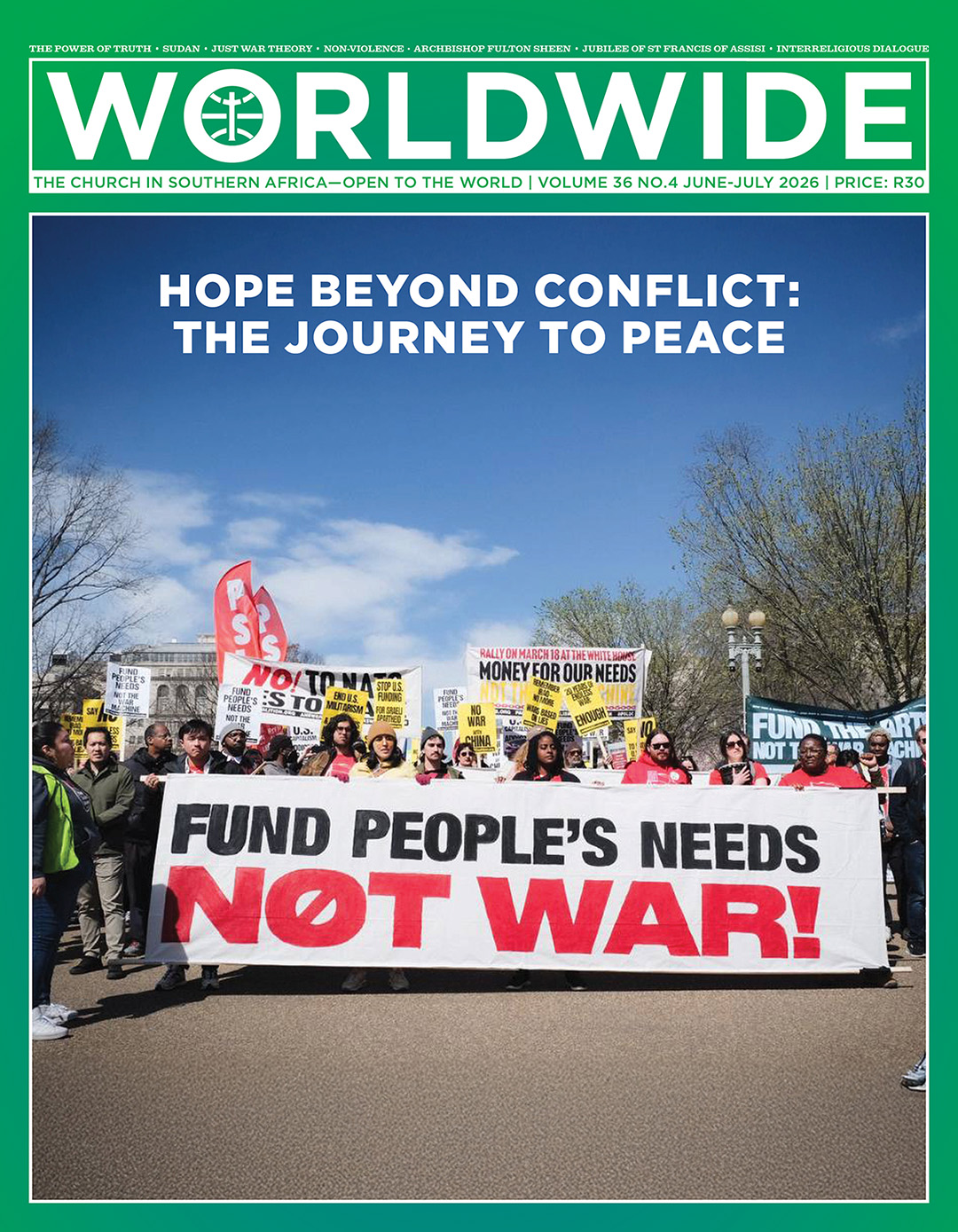
HOPE BEYOND CONFLICT: THE JOURNEY TO PEACE
“It is no coincidence that repeated calls to increase military spending, and the choices that follow, are presented by many government leaders as a justified response to external threats. The idea of the deterrent power of military might, especially nuclear deterrence, is based on the irrationality of relations between nations, built not on law, justice and trust, but on fear and domination by force.”
Message of Pope Leo XIV for the World Day of Peace 1 January 2026.
Cover Photo: Protesters in Ohio rally against US funding for the Russia‑Ukraine war, March 18, 2023. | Credit: Vincent Tsai/Peoples Watch
Witness • Jubilee
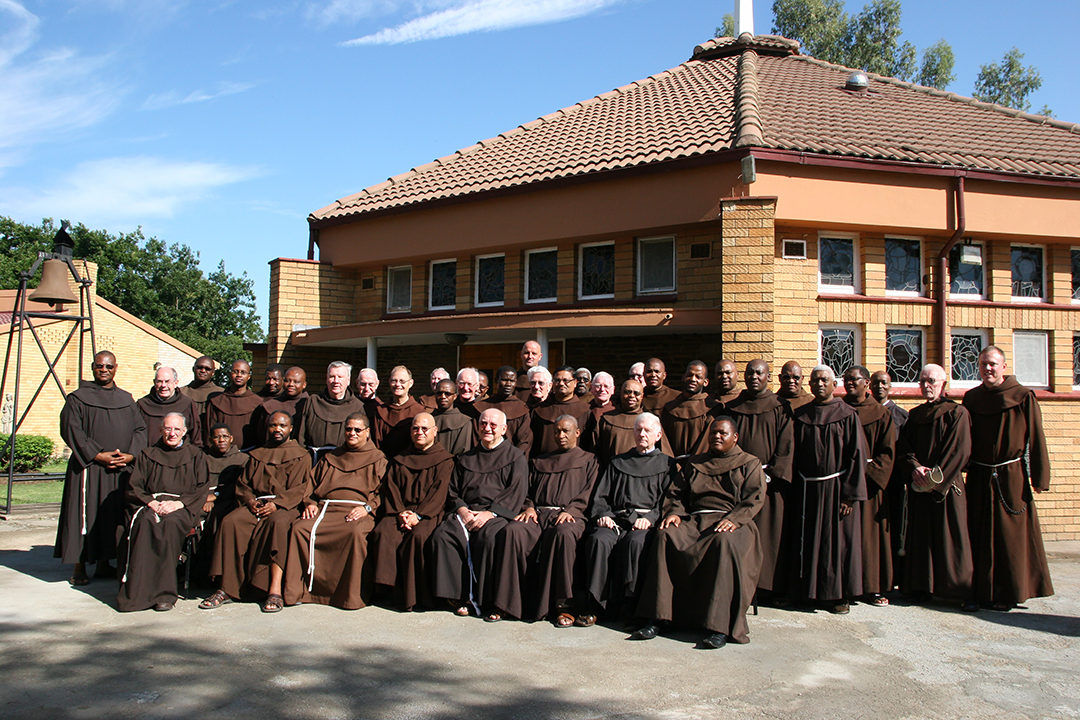
Jubilee Year Of Saint Francis – 800 Years After His Death: A Saint Of Our Times
Care for creation, love for the least among us, and commitment to peace and reconciliation are the legacy of the poor man of Assisi, who strove to conform to Jesus Christ.
BY ARCHBISHOP EMERITUS WILLIAM SLATTERY OFM
IN HIS letter this year inviting the Church to celebrate the eighth centenary of the death of Saint Francis of Assisi, Pope Leo XIV noted that Saint Francis had heard a call, instructing us: “The Lord revealed to me that we should say this greeting. May the Lord give you peace.” Peace, the Pope wrote, is the sum of all God’s gifts; it is the first gift that Jesus brought back from death on Easter Sunday evening to give to His Church. The Pope prays that this message of peace may find a profound echo in the Church and society today.
The Awakening Of His Religious Consciousness
As a young man, Francis grew up in a violent world, much like our current unsettled times. Before the age of 20, he set out twice to become a soldier. Both times, he returned home having failed in this quest. He began to realize that the celebrity status he sought was devoid of meaning. He began to suspect that peace and happiness were to be found in God. He started to pray. His companions, of whom he was the leader, suddenly began to find his behaviour strange, as he no longer wished to join their parties and games. He fell out with his father, a merchant, and left his business enterprise.
Three turning points in his early life helped Francis discover the way to Christ. Once, riding a horse close to his hometown of Assisi, he met a leper. He was terrified of leprosy and turned to run away. But the Jesus he was beginning to meet in prayer had loved the poor and even the lepers. Francis turned around and embraced this leper, He began to serve the lepers, huddled together, abandoned by all, by washing them, bringing food and clothes, and nursing them. This awakened a religious consciousness in his soul.
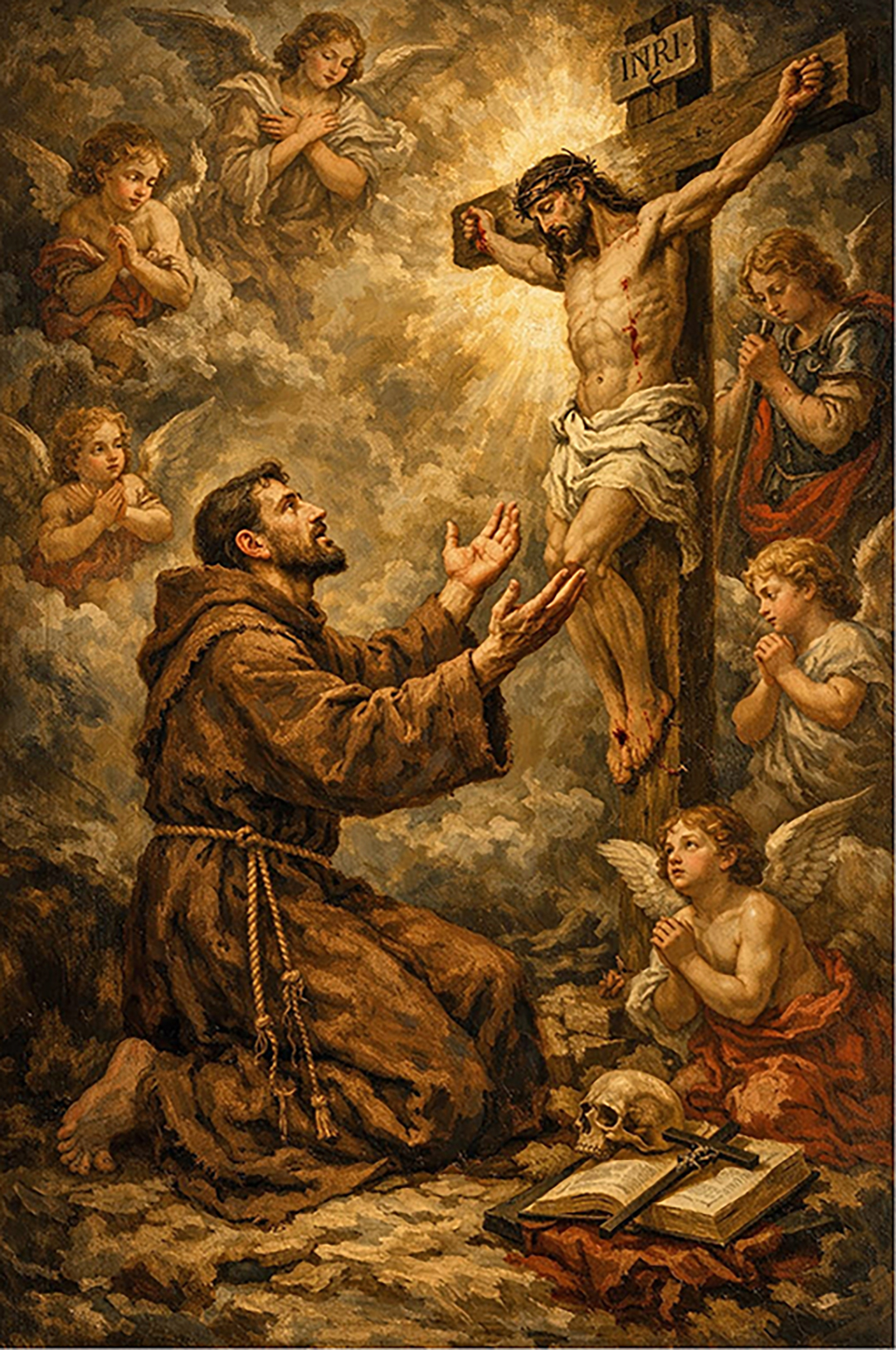
Credit: Slattery
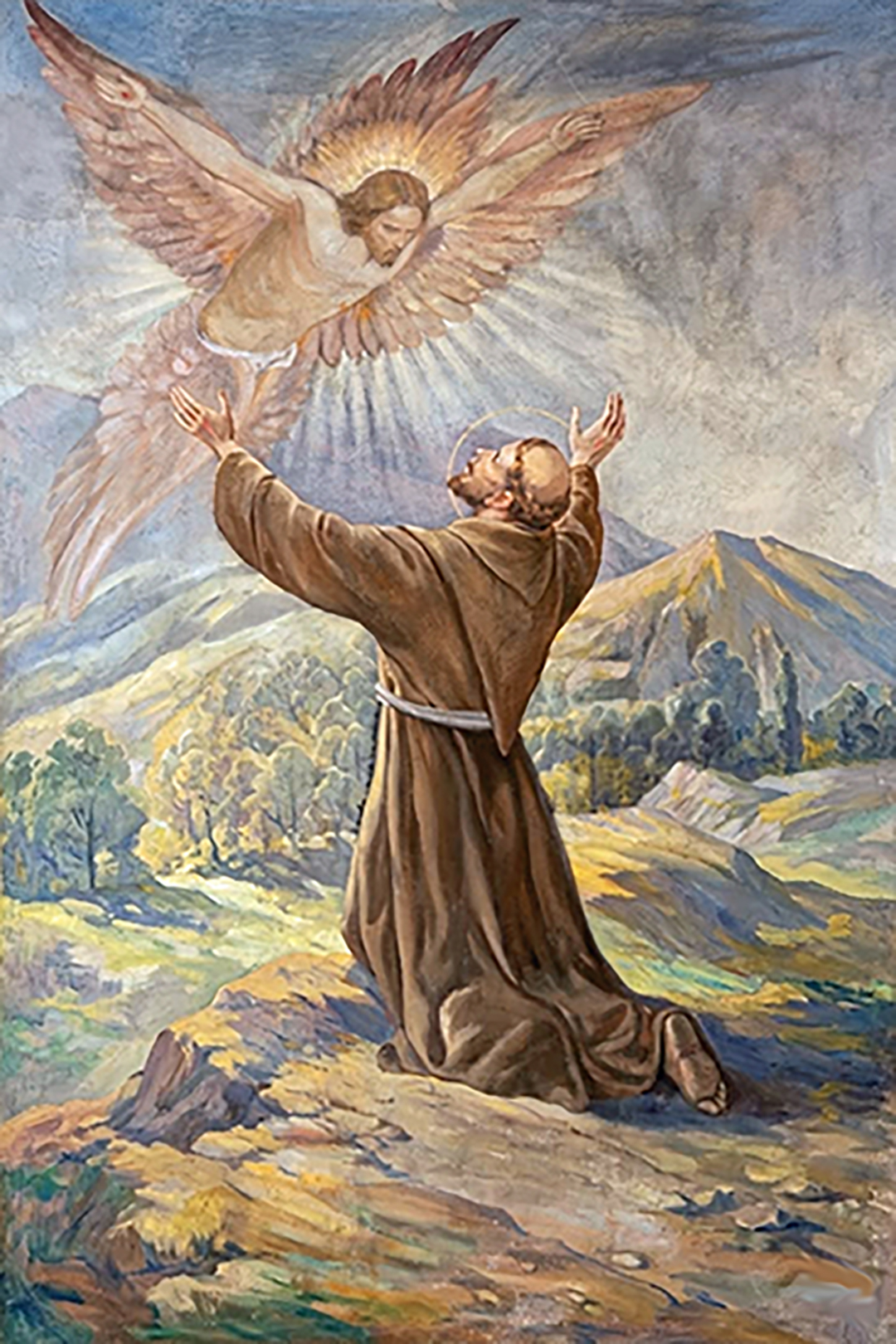
Credit: Slattery
Praying in an abandoned church in the countryside, Francis heard Jesus speak to him from the cross. “Francis, go and repair my church”. Bringing stones to rebuild the church, he observed how spiritually neglected the people were, and by words, songs, and dance, he began to share Jesus by telling them of God’s great love for each one. While he became the laughingstock of his former companions, many of the poor turned to him.
One morning, as the priest was reading the Gospel, Francis heard the following words: “Preach the message. The Kingdom of Heaven is at hand. Do not keep gold, or silver, or money in your girdles, no wallet for your journey, nor two tunics, nor sandals, nor staff. Go into the whole world and preach the Kingdom of God is at hand. Say in whatever house you enter; peace be with you”. Filled with joy Francis sang, “This is what I have been looking for. This is what I long to do with all my heart”.
Francis preached that Jesus came to bring peace and to reconcile people with each other.
Peace Had Many Beautiful Daughters
In this way, Francis of Assisi began his life according to the Gospel. Francis was not just simply imitating Christ; he was actively participating in the life of Christ, led to do so by the ‘Spirit of the Lord. He was now convinced that a life of faith was grace. And that ethics is simply gratitude, that virtue is the practice of appreciation. The Christ whom Francis passionately loved was the Christ suffering for us, abandoned, humiliated, impoverished, and stripped of all the manifestations of his wisdom, power, royalty, and divinity.
Gradually, other young men came to join his way of life, to serve the poor with him, and to discover the beautiful radiance of Jesus Christ. Pope Innocent approved his simple rule and sent him to preach to the neglected poor. Francis preached that Jesus came to bring peace and to reconcile people with each other.
The peace that Francis preached bore many Beautiful Daughters: Among them was Simplicity, drawing us away from greed and appropriation. Sisters Humility and Minority rescued people from domination, triumphalism, and power. Sisters Gratuity and Generosity moved society from exploitation, corruption, and a contractual understanding of fraternity. Sisters Cordiality and Magnanimity moved people from elitism and inequality towards relationships that were much more than virtual and computerized and distant. By reconciliation, Francis led society away from tensions, which cripple our world. (South Africa has not yet achieved any meaningful reconciliation between its different peoples.) In beautiful daughter Joy, he opened to people a sense of hope, a sense that society was more than hedonism and instant pleasure. By Wisdom, Francis brought people to a life of inner unity, removed from uncritical banal fads, web surfing and TV spots.
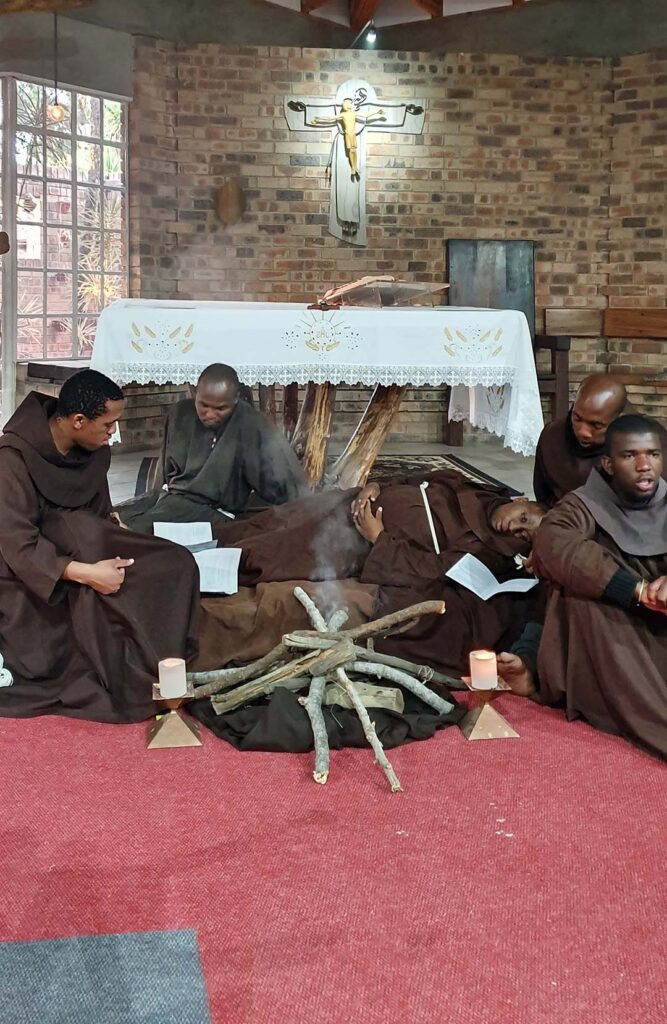
Francis’s message of peace and reconciliation was for individuals, cities, and indeed different religions. In his hometown of Assisi, the Bishop and the Mayor were at loggerheads. Francis composed a song, “The Canticle of Brother Sun,” and sang it for them, after which they reconciled and made peace. When Francis went to the great university city of Bologna, he preached with enormous impact. An old man many years later reported, “I was a student in Bologna, and I saw Saint Francis preach in the marketplace in front of the whole town. The entire theme of his discourse was to assuage enmities and to create peace. His appearance was insignificant, his face not handsome, but God gave his words such power that many noble families, between whom there was much on-going hatred and spilled blood, allowed themselves to be persuaded to make peace”.
At the time of Saint Francis, the Christian Crusades were at war in the Holy Land, liberating Christian Holy Sites from the Muslims. Francis traveled to the areas where the army was involved. Instead of joining the fighting, he simply took one brother, left the Christian camp and walked towards the Muslim army. He was taken to the Sultan. Francis preached peace to him and was welcomed with friendship in return.
There are some 12 Congregations of sisters who transform the lives of the poor and marginalized.
The secret of Francis’s life was his deep love for God. “The moment he heard the love of God being mentioned”, writes Saint Bonaventure, “he was aroused immediately and so deeply moved and inflamed that it seemed as if the deepest chord in his heart had been plucked”. Two years before his death, while praying intensely and by himself on the mountain of La Verna, he received the five wounds of the crucified Jesus on his own body.
He Saw God’s Likeness Imprinted On Creation
His companions tell us that in everything beautiful Francis saw Him who is beauty itself, and he followed his Beloved everywhere with His likeness imprinted on creation. Pope Francis calling the whole world to respect creation itself, drew on the inspiration of Saint Francis. As everything in existence is a gift from God, we must receive this graciously and warmly. Reach out and greet Brother Sun and Sister Moon, Brother Fire and Sister Water, and all weather conditions.
Inspired by Saint Francis, Pope Francis shows us (also in South Africa) many practical ways in which we can respect God’s gift of creation. We must avoid the use of plastic and paper, reduce water consumption and wastage, and should separate refuse, re-cycling what we can. We should cook only what can reasonably be consumed. We must show compassion and care for fellow living beings. We should use public transport or start carpooling. We should plant trees and turn off unnecessary lights. All of these actions show an appreciation of God’s beautiful creation and provision for future generations.
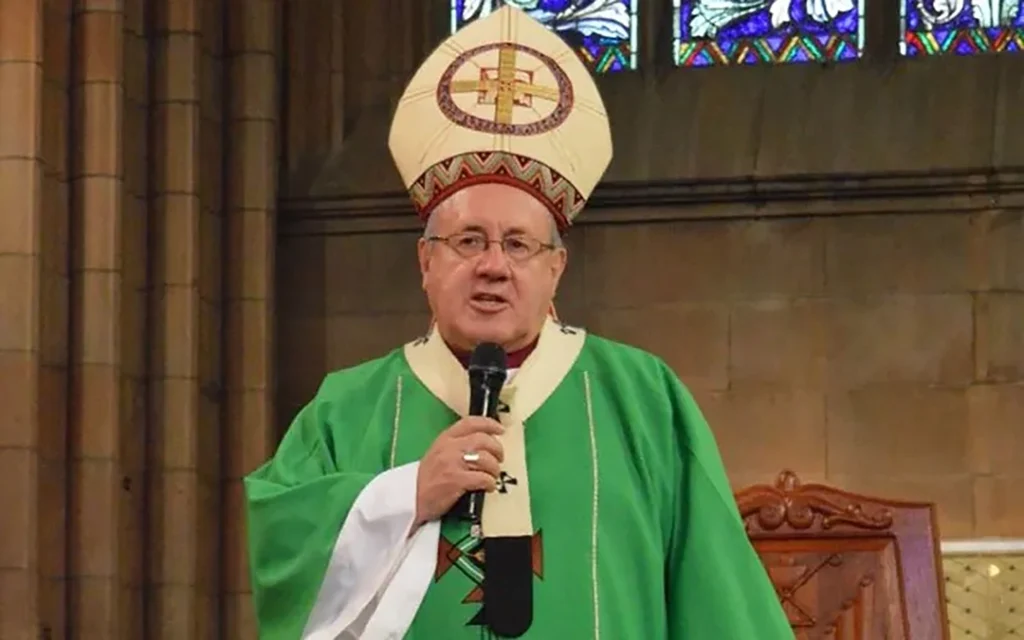
Credit: Courtesy Photo | Source: aciafrica.org
His Spirituality Overflows Into Countless Rivers
In the lifetime of Saint Francis, the Franciscan order grew enormously and carried on growing for some 800 years. These were the pioneer missionaries who went to the Holy Land to safeguard the places sacred to the memory of Jesus. Today all visitors and pilgrims are welcomed by Franciscans at these sites. They originally Christianized South and Central and North America. They traveled within a few years of the death of Saint Francis to the East and to China itself.
There are some 12 Congregations of sisters who transform the lives of the poor and marginalized. In South Africa, the Franciscan charism is represented by many religious sisters. There are some 12 Congregations of sisters who transform the lives of the poor and marginalized. In the spirit of Francis’ conversation with the Muslims, we remember Father Donal O’ Mahony, a Capuchin, who led interfaith (one word) discussions for many years. The Franciscans, during the years when the government was trying to create a Zulu homeland, fought vigorously for the sake of the people who were being removed from their homes and ancient villages. The friars sat in the middle of the roads to prevent the military trucks from removing the people. Ten of them were subsequently expelled from the country. We also fondly remember the Skill Center established by Father Stan Brennan in Boksburg, which created study facilities for adult people in the East Rand. Each year over 1000 students wrote their matric exams at Father Stan’s College.
Francis gave spirituality its real purpose, namely union with Christ. He gives spirituality the simplest of methods: striving for conformity with Jesus Christ. The spirituality of Saint Francis started from a humble wellspring gushing from the heart of the poor man of Assisi. It overflowed into countless rivers and still refreshes Christian souls. The birth and growth of this spirituality is one of the great outstanding events in religious history and proves that the influence of Saint Francis was not only remarkable for its rapidity, its spontaneity and its efficacy, but also for its duration and its depths.

The Hands That Built the Bridge
In a world where people are obsessed with qualifications and papers to add to their portfolio to guarantee high prospects of finding employment, the author argues for something different.