
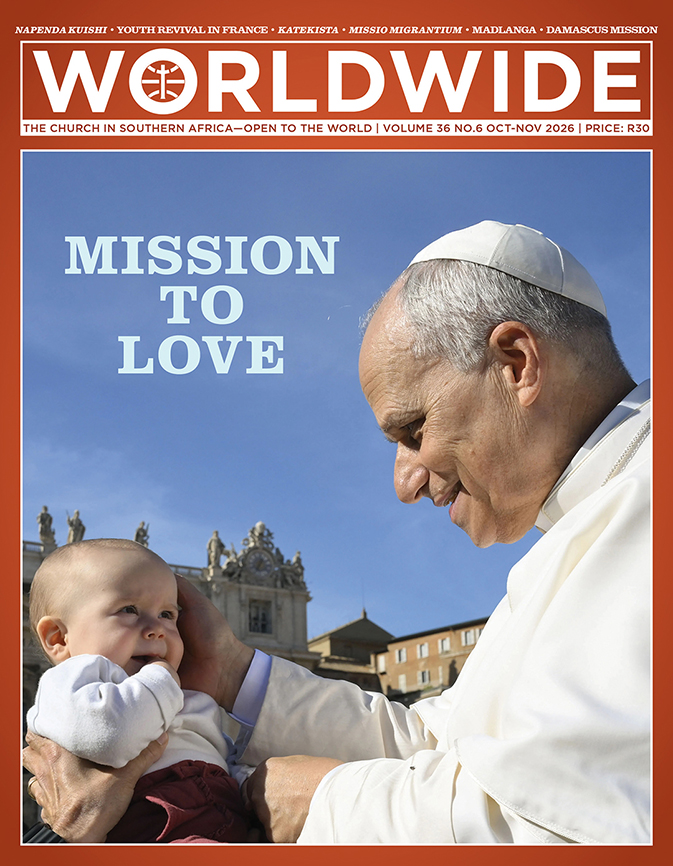
MISSION TO LOVE
Pope Leo XIV smiles while blessing a baby in St Peter’s Square—a gesture reflecting his closeness to the “little ones.” In his message for the centenary of World Mission Day in 2026, the Pontiff emphasizes: “The mission of the disciples and the Church as a whole is to continue the mission of Christ in the Holy Spirit: a mission born of love, lived in love, and leading to love” (§ 3).
Photo Credit: Francesca Pollio Fenton/aciafrica.org
Youth Voices • DAMASCUS MISSION

A CALL FOR CONTEXTUAL WITNESSING
“When the Lord awakens a vocation, he thinks not only of what you already are, but of what you will one day be, in his company and in that of others” (CV $289).
BY Jill A. Isaacs | Landscape Architect, Pretoria
NOT EVERYONE believes that they are talented or that they have a purpose in life – a Mission. Nonetheless, the best way to live fruitfully is to know what your purpose is and to pursue it. This is termed a “Vocation” from the Latin term “vocare,” meaning “to call” (Etymonline, n.d.). In his Post-Synodal Apostolic Exhortation Christus Vivit (Christ is Alive), Francis dedicated chapters eight and nine to vocation and discernment. According to him, “vocation” can be understood in a broader sense as a calling from God, including the call to life, the call to friendship with him, the call to holiness, and so forth…It makes us realise that nothing is the result of pure chance but that everything in our lives can become a way of responding to the Lord, who has a wonderful plan for us” ( CV §248). He puts it poignantly to the youth that “nothing is the result of pure chance, but everything in our lives can become a way of responding to the Lord, who has a wonderful plan for us” (CV §248).
The Youth and Vocational Discernment
The Synod of Bishops: XV Ordinary General Assembly (2018: 65) reminded the youth that each person’s life is meant to be a gift to others. Youth have the opportunity to discover this gift by asking “For whom am I?” (Christus Vivit §286), going beyond the traditional question “Who am I?” This reflects the Great Commission given by Jesus to his disciples (and to us) to be witnesses of Christ to all nations (Matthew 28:18–20). The Synod of Bishops: XV Ordinary General Assembly (2018:156) further emphasised that young people are the protagonists of change within the mission. The youth are not exempt from the Church’s missionary work.
In Christus Vivit §285, Francis invites the youth to ask some pertinent questions during their period of vocational discernment. He warns, “We should not start with wondering where we could make more money, or achieve greater recognition and social status…We need to ask: Do I know myself, quite apart from my illusions and emotions? Do I know what brings joy or sorrow to my heart? What are my strengths and weaknesses? …How can I serve people better and prove most helpful to our world and to the Church? What is my real place in the world? What can I offer to society?… Do I have the abilities needed to offer this kind of service? Could I develop those abilities?”
Church Desertion
In many churches, questions frequently arise about why youth leave the Church after Confirmation. Why aren’t they coming back? We recognise that there is a unique flame that only young people can keep burning in the life of a Church community. Their absence is seen and felt. Mangayi and Baron (2020) ask if their interest (or lack thereof) in Church reflects their interest (or disinterest) in God or the mission. There are cases where a young person or persons are only active in church activities because their parents asked them to, or because their parents are active. When their parents are not around, or when they get old, they don’t see the need to participate any longer. It was not a personal encounter that led to their activity, but rather an act of (perhaps blind) obedience. Sometimes they were/ are active and become discouraged due to the constant bickering and divisions present in their church community. Sometimes they grow weary, experience burnout, and become disheartened from the weight of responsibility placed on their shoulders.
If God was able to speak to Jonah in the belly of a great fish (Jonah 1:17), he certainly can reach anyone wherever they are and whatever they may be doing.
Where are our young people now? (Francis, 2019:202). This applies not only to a physical location, but to a heart posture and mental health. God is already at work in their lives. Not attending Church does not cancel that action. If God was able to speak to Jonah in the belly of a great fish (Jonah 1:17), he certainly can reach anyone wherever they are and whatever they may be doing. This does not mean that attending Church is not important. If they opt to attend another church in another denomination, they may find the joy, upliftment, and meaning they seek there. Perhaps they found a church with less fuss, less drama, less bickering. Perhaps the playlist in the club or tavern and the revellers there appeal to them more than church-goers who sing about loving their brethren but do the complete opposite.
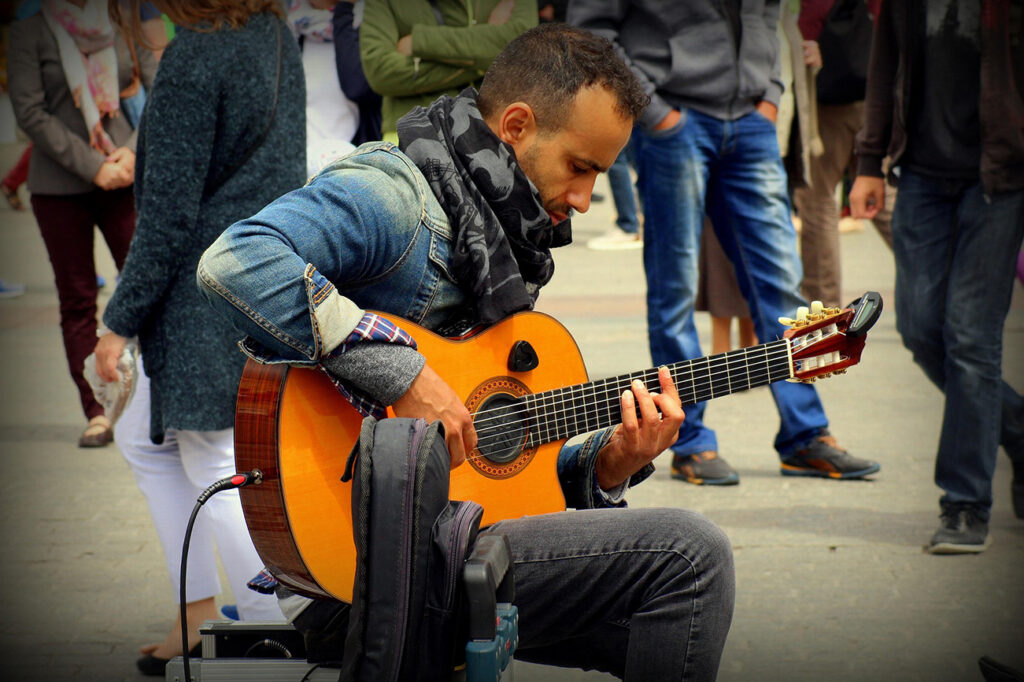
Credit: Alicja/Pixabay

Credit: Tima Miroshnichenko/Pexels
Youth Evangelizing Youth
There is great impact in youth being evangelised by other young people. The Synod of Bishops: XV Ordinary General Assembly (2018:160) explains that young people know the language of their peers, understand the unique culture of their context, the pressures faced by fellow youth, the doubts, fears and questions that young people around them grapple with, as well as what they are hopeful for and wish to see in their own lives.
Catholic youth camps and retreats also assist in this process. These are missionary hubs in fixed locations. There is a certain opportunity that arises when young people are removed from their usual context and are given the opportunity to engage with a subject matter in a different format than what they are used to (teacher-student or parent-child). Although these can be costly and thus not accessible to all, most Catholic churches offer youth retreats, recollections, and special days of prayer and encounter that are free or affordable and accessible to all. A well-structured and facilitated programme can be lifechanging. This is part of assisting young people to discern what their vocation is and can help them, already in their catechetical journey, to begin understanding not only the theory of Catholicism, but how it translates to evangelical witness.
Damascus Mission is a Catholic missionary movement in Centerburg, Ohio, and Emmitsburg, Maryland, America, that aims to awaken a spirit of adventure, mission, and love for the Eucharist through its programs, such as retreats and summer camps (Damascus, 2023). The camps include high-adrenaline sports such as rock climbing and water obstacle courses, team building, creative arts, and time for small group discussions, Mass, prayer, worship, and adoration. Testimonies are given of personal encounters after the camp and are available on their YouTube channel, @DamascusMission. One testimony of a young girl, probably about 12 years old, was that she had a vision of Jesus during adoration, who told her, “Be brave, you are my child. Come talk to me.” She received a simple message, yet a grand gesture of love and intimacy from Jesus himself.

Familiar Missionary Frontiers
After such transformative “ecstasies” (Francis, 2019:164) – ‘mountain-top’ experiences- one must go back to one’s home and begin a new life. The lessons and experiences enjoyed during a camp or retreat should be shared in love and not condemnation; in a spirit of joy and not judgement. The experience helps fill your cup, so that you can fill others. This is true missionary witness work in action.
The Synod of Bishops: XV Ordinary General Assembly (2018:3) and the Holy Father (Francis, 2019:141) encourage us to go out and evangelise all people, without exception. This means that witnessing to others must go beyond the confines of the church. One does not need to go to a different country or city to do this! This can be done in the malls or marketplaces, in schools or universities, in your own house, next door or two streets away, on the sports field or in the stands; everywhere and anywhere is the perfect spot and time to shine God’s light to others – the light that you yourself have received.
References
- Damascus. (2023). About us. Retrieved from Damascus website: https://www.damascus.net/about
- Etymonline. (n.d.). Search: Origin and history of vocation. Retrieved from Etymonline website: https://www.etymonline.com/word/vocation
- Francis, H. F. (2019, March 25). Francis: Apostolic Exhortations. Retrieved from The Holy See: Vatican website: https://www.vatican.va/content/francesco/en/apost_exhortations/documents/papa-francesco_esortazione-ap_20190325_christus-vivit.html?utm_source=chatgpt.com
- Mangayi, L. C., & Baron, E. (2020:3). Ten years (2010-2020) of exciting missiology in South Africa: trends and trajectories. Scriptura 119, 1-18.
- Synod of Bishops: XV Ordinary General Assembly. (2018, October 27). Retrieved from The Holy See: Vatican Press Website: https://press.vatican.va/roman_curia/synod/documents/rc_synod_doc_20181027_doc-final-instrumentum-xvassemblea-giovani_en.html?utm_source=chatgpt.com

Youth Fostering Integral Ecology
Guided by the theme for 2026 “Season of Creation”, the author calls for the transformation of hearts and habits to confront water pollution and protect our shared future.