
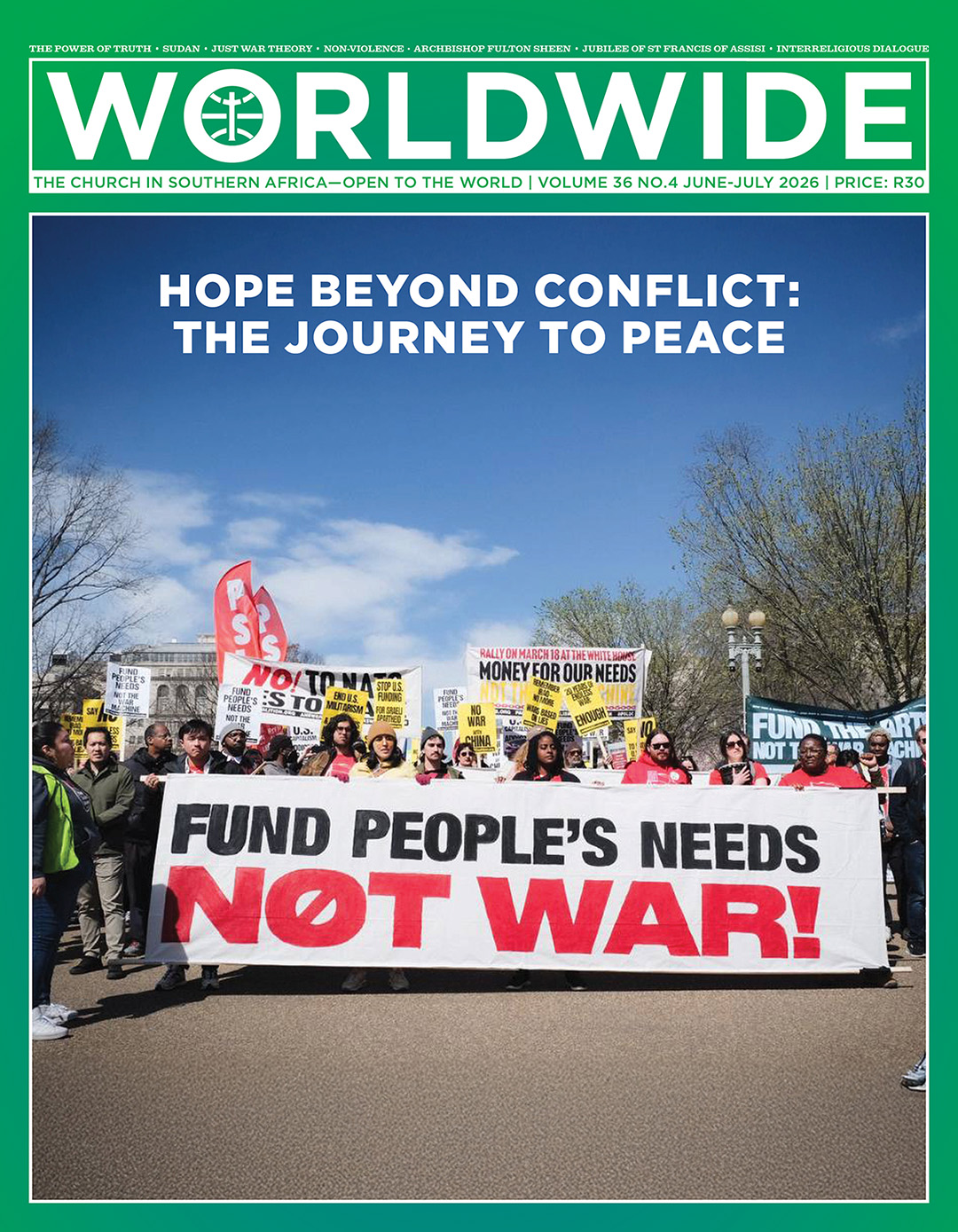
HOPE BEYOND CONFLICT: THE JOURNEY TO PEACE
“It is no coincidence that repeated calls to increase military spending, and the choices that follow, are presented by many government leaders as a justified response to external threats. The idea of the deterrent power of military might, especially nuclear deterrence, is based on the irrationality of relations between nations, built not on law, justice and trust, but on fear and domination by force.”
Message of Pope Leo XIV for the World Day of Peace 1 January 2026.
Cover Photo: Protesters in Ohio rally against US funding for the Russia‑Ukraine war, March 18, 2023. | Credit: Vincent Tsai/Peoples Watch
CHALLENGES • DIALOGUE
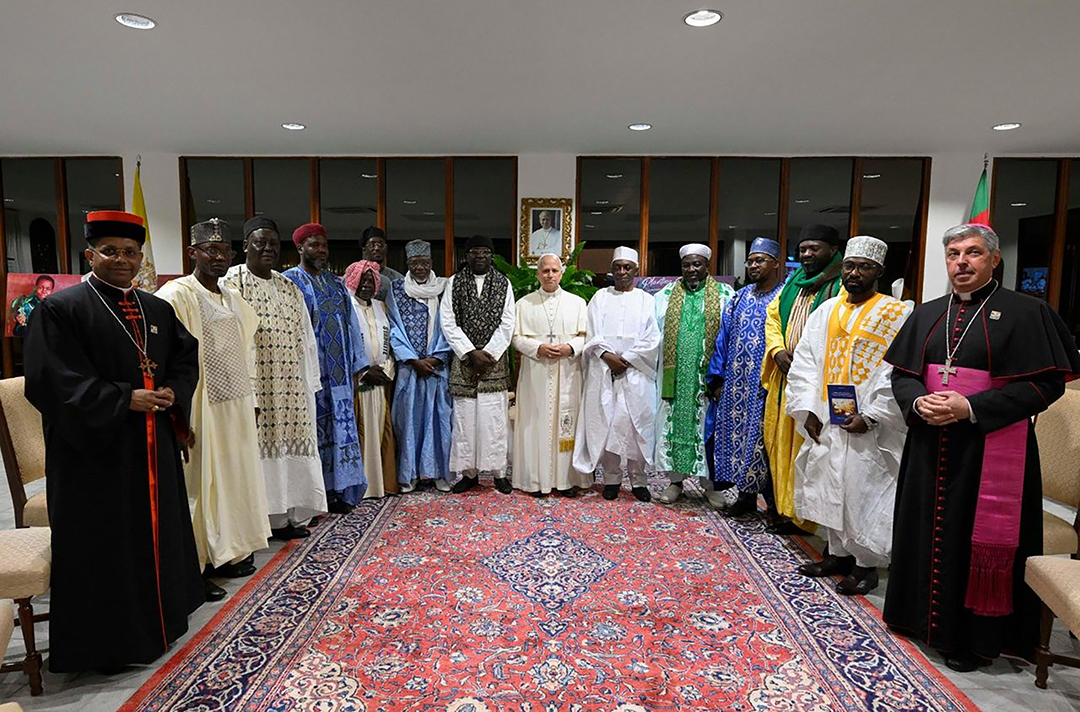
Credit: Vatican Media | Source: vaticannews.va
Healing A Wounded World: Interreligious Dialogue For Peace In The Vision Of Pope Francis And Pope Leo XIV
While the world continues to suffer the effects of wars locally and globally, and nations stockpile arms in preparation for defense and offence, the author argues for a different approach one rooted not in weapons, but in dialogue.
BY REV DR ISAAC MUTELO OP, PEDRO ARRUPE UNIVERSITY | HARARE, ZIMBABWE
WE LIVE in a wounded and deeply troubled world. Individuals and families continue to be displaced by war, communities are divided by fear and mistrust, and social media often turns suspicion into outrage before people have even had time to think. In such a context, interreligious dialogue can be regarded as a mission for believers who are passionate about bringing healing to a wounded and troubled world. For Christians, dialogue with people of other religions and faiths is not an accessory to mission but part of its very heart.
Like Pope Francis, and before him, Pope Leo XIV has consistently strengthened this vision in a very direct way. Speaking to the Programme for Christian-Muslim Relations in Africa on Wednesday, 25 March 2026, he thanked those working to foster “fraternity between Christians and Muslims”. He emphasized that their ongoing dialogue was “a positive sign” that can help peace, justice, and hope flourish in African societies and beyond (The Holy See 2026). He also noted that “in a world increasingly marked by religious radicalization, division, and conflict, your common witness shows that it is possible to live and work together in peace and harmony, despite cultural and religious differences” (The Holy See 2026). These words are a clear reminder that the Church’s missionary presence in the contemporary world must be both evangelizing and reconciliatory, rooted in friendship, listening, and common service.
A Wounded World In Need Of Mission Through Encounter
War continues to wound human life in conflict zones such as Gaza, Ukraine, Sudan, Iran, Myanmar, and many others. Pope Francis repeatedly called these by name when he stressed that, “wars are a disaster for the peoples and a defeat for humanity,” and linked that judgment to his appeals for peace in conflict zones and for respect for civilians, especially the vulnerable (Vatican News 2024). When we consider his conviction that ‘war is a defeat for humanity,’ what we really evoke is more than just a papal slogan. We, in fact, are stating a moral truth. War, in most cases, destroys homes, families, schools, trust, and memory, and its wounds remain long after the guns fall silent.
What makes our times even more perilous is that religion is sometimes dragged into these conflicts. For instance, Christians, Muslims, and Jews can become symbols in political struggles even when the real causes of violence are land, power, revenge, or ideology. Religion itself is neither harmful nor the enemy, but it can be manipulated by those who use fear or manipulation as a tool. When that happens, the sacred becomes devoid of mercy, compassion, and love and turns into the stigma of exclusion, division, and conflict.
For most religious congregations, this is a familiar terrain. For instance, part of the mission for Missionaries of Africa on Christian-Muslim relations and dialogue is to remain “particularly sensitive to the concerns of the Islamic world and interreligious dialogue,” which is anchored in their commitments that are lived out through primary evangelization, justice, and peace (Missionaries of Africa). This implies that dialogue is not simply an option but a part of how the Gospel is embodied in Africa and beyond.
Pope Leo XIV recently verbalized the same truth in a striking way. In his reflection on the 60th anniversary of Nostra aetate, he emphasized that a seed planted for interreligious dialogue becomes “a mighty tree,” bearing the fruits of “understanding, friendship, cooperation and peace” (Wells 2025). That image is especially crucial for mission work because it demonstrates that dialogue is neither weakness nor compromise but growth. It is how trust takes root over time, through shared patient relationships, bearing the great responsibility to instill “hope to a humanity that is often tempted by despair” (Wells 2025).
In most cases, this is not complex. It actually begins with simple gestures: greeting a Muslim neighbour with sincerity, attending local celebrations or funerals with respect, visiting the sick across religious lines, and listening before speaking. These ordinary everyday but important habits carry missionary force because they show that the Christian faith is capable of friendship without fear or suspicion. In a polarized world, this kind of ordinary presence may actually be the most persuasive preaching of all. This is also in line with a directive from the Rule of 1221 (Chapter XVII) written by St Francis of Assisi that “Let all the brothers, however, preach by their deeds”, which emphasizes authentic, action-based witness over mere verbal declarations (McCloskey 2025).
Shared Moral Ground
Most contexts today show that interreligious dialogue becomes more effective when it is built on what different communities already hold in common. Christianity, Islam, and Judaism all affirm the dignity of the human person, the value of mercy, the duty to care for the poor, and the responsibility to seek justice. Pope Leo XIV’s message to Christian and Muslim leaders in Africa reflects that same conviction: dialogue should deepen “Christian-Muslim cooperation for the sake of the common good” (The Holy See 2026). He also stressed that these encounters should bear fruit in “grassroots initiatives to promote social friendship” (The Holy See 2026).
Pope Leo XIV’s assertions are important because dialogue should not remain at the level of polite statements. It should become concrete or practical in bringing peace, healing, and reconciliation to a wounded world. For example, a Christian parish and a mosque could collaborate with food support for displaced families. Similarly, a synagogue, church, and Islamic centre could organize youth discussions on solidarity, peace, and hate speech. A small Christian community and local faith group could respond together to floods, hunger, or school needs. These projects do more than solve problems. In most cases, they create relationships, and relationships are what resist violence and division over the long term.
Pope Francis often described this deeper vision as human fraternity. He spoke of the need to place fraternity at the centre of social life, so that “in a planet on fire”, we may reiterate our ‘no’ to war and ‘yes’ to peace, testifying to the humanity that unites us and makes us recognize others, in the mutual gift of our respective cultural differences” (Zengarini 2024). This merges beautifully with the Christian call to be close to others, especially where religion, ethnicity, and politics are often enmeshed and interwoven.
Obstacles On The Road
Healing a wounded world through Interreligious dialogue in times of war and division is not easy. Some communities around the world today carry painful memories of war, discrimination, or attacks committed in the name of religion. Some believers might even fear that dialogue means surrendering their convictions or even ‘dining with the enemy. Others have been taught from childhood to distrust people of any other faith. One could add to that the role and influence of social media, where Islamophobia, false claims and hateful speech spread quickly, and the task becomes even harder. It is not surprising that Pope Leo XIV has warned Christians and Muslims to resist the “growing danger of apathy” in modern society (Martínez-Bordiú 2026). That caution is relevant here because in some contexts today, indifference can be just as damaging as open hostility. When people stop caring about the suffering of others, they lose the desire to build peace. Dialogue then becomes difficult not only because of hatred, but because of apathy and numbness. Added to that is a spiritual challenge. Religious life can be reduced to identity politics, where faith becomes a way to defend group pride instead of serving God and neighbour. Pope Francis repeatedly rejected this kind of distortion when he insisted that war is not only destructive but deceptive, because it promises security while producing deeper insecurity. Dialogue asks for more than good manners; it asks for conversion of heart (Zengarini 2024).
Way Forward
The foregoing discussion shows that the future depends on cultivating new habits. Children and young people should learn from the outset that members of other religions are not enemies. Schools, parishes, and catechetical programs must teach respect by introducing students to the beliefs and practices of others without ridicule or fear. The goal is not relativism, but maturity. At local level, missionary congregations, dioceses, and parishes can help create shared spaces of encounter with members of other religions: reading groups, community meals, peace workshops, joint prayer days, and visits to families in need. In such settings, religion becomes visible as a force for healing rather than division. Pope Leo XIV’s call to promote “social friendship” through grassroots action offers a very practical model for this kind of work (The Holy See 2026). In his 11-day apostolic journey to Africa, he called for more dialogue and unity and condemned the use of religion to justify hatred and violence (OSV News 2026).
Peace Through Dialogue
The world does not need more reasons to hate. It needs Christians who can cross lines others have drawn too sharply. Interreligious dialogue will not solve every conflict, but it can create the trust needed for peace to begin. It can keep communities from collapsing into fear. It can remind believers that God is not honoured by dehumanizing the “other”. Indeed, dialogue can foster peace, justice, hope, and advance and serve the common good. The conviction that war is a defeat for humanity is crucial in a world obsessed with violence. For Christians, the road ahead is therefore both spiritual and practical: to remain close to members of other religions, to build bridges, and to help the world rediscover that fraternity is not an ideal for tomorrow but a duty for today.
References:
- Almudena Martinez-Bordiú (2026, May 11). Pope Leo XIV urges Christians and Muslims to turn indifference into solidarity. ACI Africa.
- Missionaries of Africa. (n.d.). Christian-Muslim relations and dialogue.
- McCloskey, P. (2025, October 23). Origin of Saint Francis peace prayer. Franciscan Media.
- OSV News. (2026, April 23). From conflict zones to ancient Christian sites, Pope Leo XIV brings message of peace, hope to Africa. OSV News.
- The Holy See (2026, March 25). Address to the delegation of the Programme for Christian-Muslim Relations in Africa (PROCMURA).
- The Holy See (2026, March 25). Address to participants in the PROCMURA meeting.
- Vatican News (2024, January 7). Pope appeals for peace in Myanmar, the Middle East, and Ukraine. Vatican News.
- Wells, C. (2025, October 28). Pope Leo: The message of Nostra aetate remains as urgent as ever. Jewish-Christian Relations.
- Zengarini, L: (2024, May 11). Pope Francis: War is a defeat for humanity and a deception. Vatican News.

A photo of the Atomic Energy Board, where the author started his working career.
In this article, the author shares his experience of formal employment and suggests steps one can take to guarantee a decent life after retirement.